• Categories

  • VA Purchase Tips for Home Buyers and Real Estate Agents!

    November 10th, 2017

    VA financing is one of the best mortgage products available in the market today for home buyers, as the VA makes it easy for their members to purchase a home with zero down financing. This list of VA frequently asked questions and VA tips will help you understand the in-and-outs of how the VA mortgage program works. I also included 6 tips below too that you can use to help get a VA purchase offer accepted.

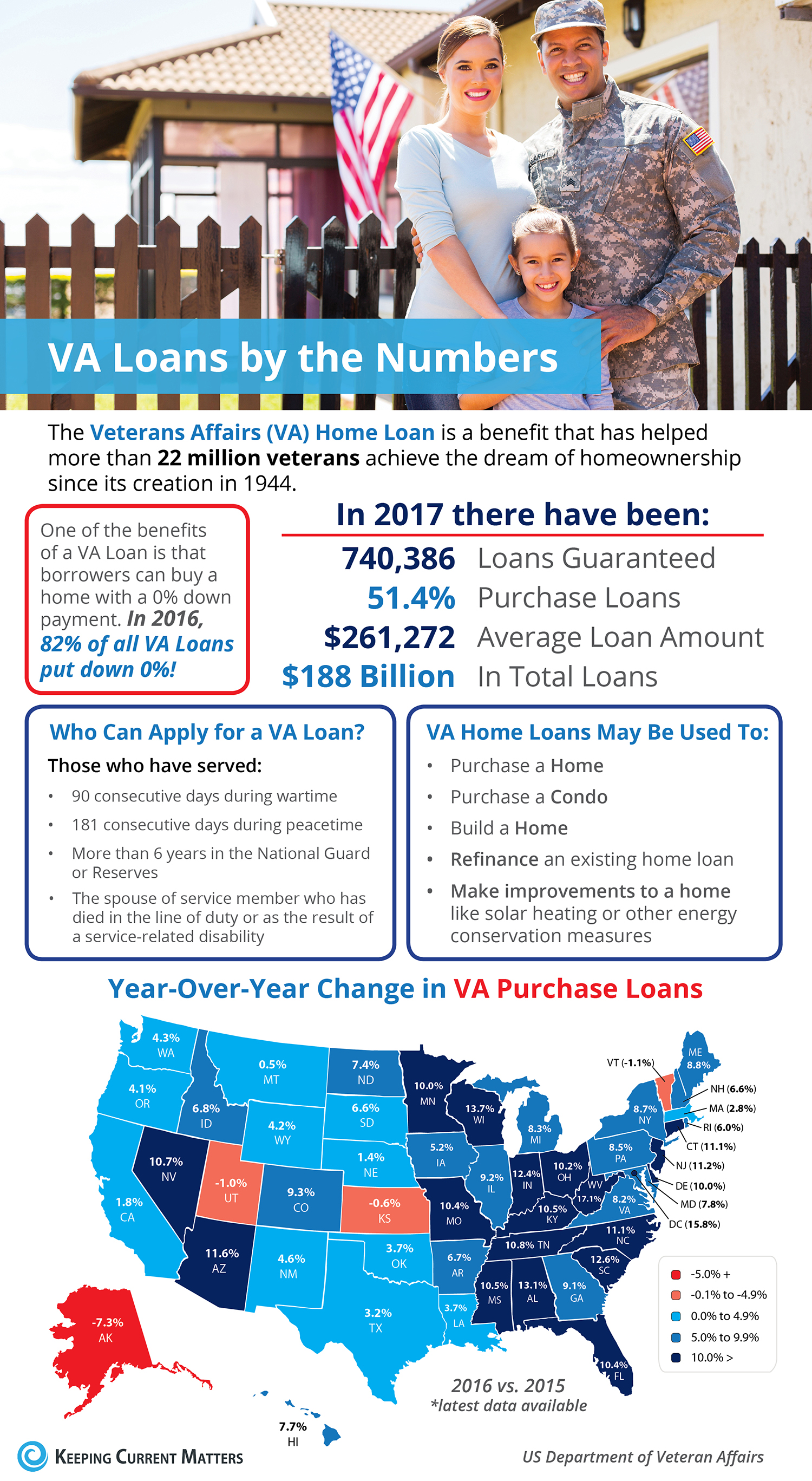
    VA Loans by the Numbers

    in 2017, 82% of all VA loans put down 0%. Here is a snapshot of who can apply for a VA loan and what type of VA financing is available.
    Who is Eligible for VA financing?

    A veteran is eligible for VA financing if he/she served on active duty in the Army, Navy, Air Force, Marine Corps, or Coast Guard and was honorably discharged after 24 continuous months of active duty, or the full period for which called, or ordered to active duty, but not less than 90 days (during wartime) or 181 continuous days (during peacetime).

    How Much Home Can I purchase With a Zero Down VA Mortgage?

    VA buyers qualify for zero down financing up to their county loan limit. For example, a VA buyer can get zero down financing in San Diego up to $612,950, $636,150 in LA county and Orange County, and $424,100 for Riverside county. You can check your county loan limit HERE .

    There is only a small down payment due if a buyer needs to purchase over the county limit. On a $700k purchase in San Diego for example, the down payment due is only $21,762.

    We can also give a VA buyer a 3% lender credit to cover ALL their closing costs. This means a VA buyer can purchase a home with No down payment due or closing costs either, and this also includes a credit for the appraisal fee.

    What is the Minimum Credit Score to Qualify For VA Financing?

    Most VA lenders require a 620 credit score to offer zero down VA financing. We have a couple of lenders who only require a 580 score to qualify for zero down financing.

    Do VA Buyers Pay Any Monthly Mortgage Insurance?

    VA buyers do not need to pay any monthly mortgage insurance (MI) on their loans even up to 100% of the property value, as VA loans are backed by the government.

    Can VA Buyers Purchase a 2-4 Unit Property?

    The VA allows their military buyers to purchase a 2-4 unit home with zero down VA financing. VA financing is for owner occupied financing, so the VA borrower would live in one unit and rent out the other 1-3 units.

    You can also use the rental income from the other 1-3 units to qualify for a loan. This is a great way for VA homebuyers to start out as a real estate investor.

    • You can finance up to a loan amount of $784,700 on a 2 unit property.
    • You can finance up to a loan amount of $948,500 on a 3 unit property.
    • You can finance up to a loan amount of $1,178,750 on a 4 unit property.

    How are VA interest Rates Compared to Other Loan Programs?

    VA mortgage rates are the lowest in the industry and are typically .375% lower than conventional rates.

    What is the VA Mortgage Waiting Period after a Foreclosure, Short sale or Bankruptcy?

    Short Sale: It is only 2 years before a buyer can repurchase again using VA financing.

    Foreclosure: It is only 2 years before a buyer can repurchase again using VA financing.

    Bankruptcy: For a chapter 7 Bankruptcy it is 2 years and 1 year for a chapter 13, before a buyer can repurchase again using VA financing.

    Tips for VA Buyers and Sellers – The Misconception Sellers Have About VA Closing Costs

    There is a misconception out there that the seller must pay for some or all of a VA buyer’s closing costs. The seller is NOT required to pay ANY costs for the buyer, but is allowed to pay up to 4% for VA loans.

    But there are certain “VA non-allowable” costs for which a VA buyer is forbidden to pay, (for example No escrow fees, wiring, notary, tax service or processing fees etc are allowed to be charged).

    Here is a good tip to help get a VA offer accepted, so this issue of who covers these VA non allowable fees does not become an issue. Write the following verbiage in the purchase contract, so the seller is not put off by the VA offer: “Seller not responsible for any buyer closing costs, regardless of the selected loan program. All agency-related “non-allowable” costs to be borne/paid by lender”.

    This means the VA Non-Allowable fees will be paid by a lender credit instead of the seller, we do this for all our VA buyers.

    So now the seller will NOT dismiss the VA offer right away, does NOT have to cover any closing costs, negotiations are easier, and the buyer and seller can strike a deal.

    6 Tips to Help Get Your VA Purchase Offer Accepted

    Sometimes I hear from buyers and agents that it is tougher to get a VA purchase offer accepted. It is true that some sellers will look the other way when they see a VA purchase offer, due to the zero down payment “no skin in the game”, and the assumption they will also need to cover the VA closing costs. Here are 6 tips to help your VA purchase offer get accepted

    1. Include a personal cover letter with your purchase offer

    A good idea in this competitive housing market is for the buyers to write a personal cover letter to the seller. Include this letter with your offer that introduces the family and why they are the right candidate to purchase the home. Include a family picture too.

    If you can tug at the heart strings of the seller, they may be more inclined to choose your offer over others. There are plenty of sellers who will be happy to sell their home to a military family to thank them for their service. Many agents and buyers tell me this strategy works!

    2. Include a VA DU underwriting approval with your offer

    Include a VA DU underwriting approval with your offer. A DU (desktop) underwriting approval is when a buyer’s loan application and credit report has been ran through the VA’s automated underwriting systems and was approved.

    A DU underwriting approval displays the most important information on a buyer’s profile, which gives the seller a better idea of the strength of the buyer. For example, a DU approval displays a buyer’s credit scores, debt to income ratios, assets, reserves, any applicable down payment and the type of loan program they are approved for.

    3. Provide proof of reserves/assets/down payment funds to strengthen offer

    The zero down payment requirement with VA means less skin in the game. We can’t argue with this because VA allows 100% financing, so this does amount to very “little skin in the game” from a buyer.

    Therefore it’s a good idea to include proof of reserves and assets and any applicable down payment funds along with your offer, so this shows the seller the buyer has applicable funds to close if any additional funds are needed to close the transaction.

    4. Increase your deposit

    Want to show a seller how serious your offer is? Consider putting down a bigger deposit in earnest money. This may seem risky for some, but earnest money is there for a reason. If you are uncertain about putting a “noticeable” amount of earnest money on the table, it may be a sign to the seller that you are uncertain about the house itself.

    Assuming you hold up your end of the bargain and you have the right contingencies in place, it won’t cost you any more in the long run since the deposit goes towards your down payment if financing is involved.

    *As a VA buyer typically qualifies for zero down financing, they will get their deposit back at closing

    5. Be flexible and don’t ask for any seller credits

    It’s a good idea to ask the seller’s agent upfront what you can do to make the offer more enticing to the sellers.

    For example, can you be flexible on the closing date for the seller?

    Also, a purchase offer asking for seller credits to pay for your closing costs will usually place behind an offer that does NOT ask for any seller credits.

    SOLUTION: To make a buyers offer more competitive, the lender can pay for some or ALL the buyers closing costs with a lender credit.

    How does this work? Instead of taking say a 4% 30 year fixed rate, take a higher rate of 4.25% instead, and now there is a lender credit of roughly 2% available that can be used to pay towards a buyers closing costs.

    Not only is this a good negotiating tactic so the buyer and seller can strike a deal, but of course it saves a buyer money too. We present this option to all our buyers.

    Another Tip. In today’s competitive purchase market, another tip is to offer to pay for the sellers Owners title policy and transfer tax. These fees only amount to roughly $2,500 on a $400k home.

    6. Close the Transaction Faster

    Being able to close a transaction faster is another way to entice the seller to accept your offer in this competitive market.

    For example, if a seller is reviewing 3 offers, and there is a 21 day offer, a 30 day and 45 day offer, often the seller will go with the faster closing.

    My company Citywide Financial Corp can close a Conventional, FHA or VA Purchase Transaction in 17 – 21 days. We have an outstanding team set up and dedicated to help close transactions fast.

    If you have any questions about any of these tips above or getting approved for financing, please do not hesitate to contact me directly at 858-442-2686. I look forward to chatting soon.

    P.S. If you would like to be updated faster on important industry news or any new loan programs that come out, please join my Facebook page .

    How to Qualify for a Cash-Out Refinance

    October 9th, 2017

    As home values and home equity continues to increase in most parts of California, many homeowners are tapping into their home equity and borrowing cash-out to pay for home improvement projects, tuition for their children, or to consolidate high interest rate credit cards and save money monthly. There are 4 different mortgage programs you can use to refinance and borrow cash-out. Here is how to qualify.

    There are 4 different mortgage programs you can use to borrow cash-out.

    The 3 different mortgage programs you can use to refinance and borrow cash-out, are Conventional, FHA and VA financing. Here are their current cash-out refinance rules.

    1. Conventional financing allows you to cash-out refinance up to 80% of the property value. Cash-out refinances are available on primary residences, 2nd homes or investment properties.

    Conventional cash-out refinances also qualify for the new appraisal waiver program, see below. The rate for a cash-out refinance loan is a little higher than a non cash-out refinance.

    2. FHA financing allows you to do a cash-out refinance up to 85% of your property value. The interest rate on a FHA loan is the same for a cash-out versus non-cash-out refinance.

    3. VA Financing allows you to do a cash-out refinance up to 100% of your property value. The interest rate on a VA loan is the same for a cash-out versus non-cash-out refinance. There is No monthly mortgage insurance on a VA loan even up to 100% of the property value.

    4. HELOC (Home Equity Line of Credit). A Home Equity Line of Credit is a 2nd mortgage behind a first mortgage. The payment is calculated using the balance on the loan. This is a good tool for homeowners, as you can borrow against the line of credit anytime you want. Ask me for more details how to qualify.

    The Benefits of a Cash-Out Consolidation Refinance

    A cash-out or consolidation refinance is a great way to payoff high interest rate credit cards with balances that never seem to move lower. Consolidating credit cards and other personal debts will save the average homeowner up to $300 – $500 a month.

    A great idea is to reinvest the monthly savings back into the loan to pay it down faster, or you can reinvest the monthly savings back into your 401k retirement fund or a college fund for your children (see below the example).

    The interest is also tax deductible when you borrow against your home, so once you consolidate all the credit cards with a new mortgage refinance, you can now write off all the interest that you were paying on the credit cards.

    Check out this consolidation mortgage below that my company just funded for a client.

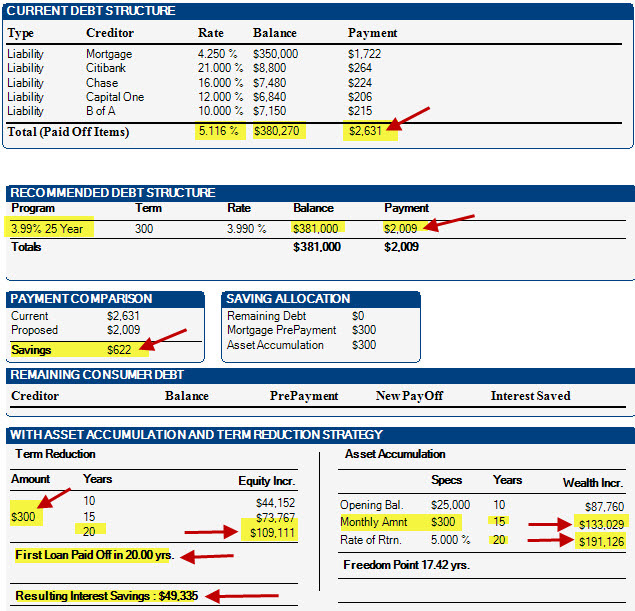
    Our client had a rate of 4.25% on a 30 year fixed and had 28 years left on the mortgage. He had 4 credit cards that had rates over 10%. His total monthly payments including the mortgage and 4 credit cards were $2,631 a month.

    We helped him refinance into a 25 year fixed at 3.99% and paid off the 4 credit cards. His new monthly mortgage payment was $2,009. This saved him $609 a month.

    Our client is going to put $300 of the $609 monthly savings back into the loan each month to help pay it off faster. By doing this it will pay off the 30-year mortgage in only 20 years (see above).

    He is also going put the other $300 monthly savings into a college fund for his 2 small children, so he can build a college fund to help pay their tuition costs. After 15 years his college investment fund will accumulate to $133,029 (see above).

    If you are interested in reviewing a plan like this, just let me know and I can run all the numbers for you.

    Top Home Renovations for Maximum Return on investment 

    When planning to do renovations to your home, there is value in knowing which home improvement projects will net you the most Return on Investment. Here are the top 4 projects below that will give you the most ROI.

    Borrow Cash Out to Fund the Down Payment for a New Investment Property.

    Buying an investment property is one of the best financial investments you can make. With annual rents continuing to increase on average 3% – 4% in many parts of California, and rental vacancy rates at 30-year lows in most parts of California, purchasing an investment property is a great source of additional income.

    As you can see below, just a 4% increase in annual rent can increase a $1,500 monthly rent up to $1,974 in just 8 years, an increase of $474, which is a 32% profit in rental income for an investment property owner.

    With interest rates also still near multi decade lows, borrowers can still get a low long term fixed rate on their investment property. This is a good idea so the monthly mortgage payment never changes, but the monthly rent will probably continue to increase, which means the return on your investment will continue to increase over the long term.

    Many of our clients do a cash out refinance to obtain the down payment funds for a new investment property purchase.  Check out HERE the 4 different loan programs available to help you finance and purchase an investment property. The down payment requirements are also included in this article.

    Free Appraisal Waivers on Conventional Refinance Loans

    Fannie Mae is offering “Free Appraisal Waivers” on Conventional refinance and purchase loans. This computerized appraisal will be used to determine the value on a home, instead of having to do a physical appraisal inspection of your home. This will save homeowners $500 out of pocket for the appraisal fee.

    To determine if you qualify, we just run your loan application through the Fannie Mae conventional automated underwriting system, and their system will determine right away if your property qualifies for the appraisal waiver.

    This appraisal waiver is available for cash-out and non-cash-out refinances. It is also available for primary residence, second homes, and investment properties.

    Borrowers just need to have at least 10% equity in their primary residence home to qualify. Ask me for more details how to qualify for the appraisal waiver.

    If you have some high interest rate credit cards or other debts you would like to consolidate, or you have some home renovation projects you would like to borrow cash-out for, or you would like to borrow funds to purchase a new investment property, just let me know and I can run some numbers for you.

    I look forward to chatting soon.


    Show Millennials How to Buy a Home With a 1% Down Conventional Mortgage and No Monthly PMI

    June 8th, 2017

    A recent survey of 2,000 Millennials revealed that 77% assumed they need to put down more than 5% to purchase a home, and 53% have not purchased yet because they don’t have enough for the down payment. A mortgage program that most Millennials are probably not aware of is the new 1% down Conventional mortgage, which means they can now purchase a home for the cost of only 2 months rent. Buyers also have the option of removing the mortgage insurance “PMI” from their payment, so they can obtain an even lower monthly payment. Check out the Q&A section below how to qualify for this program.

    New Insights on Millennials and Homebuying

    A recent study of over 2,000 Millennials revealed that many of them want to become homeowners, but most think they need a larger down payment than what is required to purchase a home.

    Over 77% assumed they need to put down more than 5% to purchase a home, and 53% have not purchased yet because they don’t have enough for the down payment. Check out the other results below from the survey.

    What most Millennials are not aware of, is that they can purchase a home today with only 1% down conventional financing, and receive an additional lender credit to cover all their closing costs.

    The 1% Down Conventional Mortgage Program

    The conventional 1% down mortgage is very popular with homebuyers right now, as it is helping them purchase a home with a low down payment and a low fixed rate.

    To qualify for this new program, a buyer only has to come up with 1% down. Then the lender gives the buyer a 2% lender credit towards the down payment giving the buyer 3% equity at closing.

    For example, a buyer in San Diego can purchase a home up to $435k. They only have to put down 1% ($4,350), the lender gives them a credit of 2% at closing, which means they will have a loan amount of $421,950, which is under the conventional loan limit of $424k.

    We can also give the buyer a 2.5% broker credit to cover ALL their closing costs, which means they can purchase a home for the cost of only 2 months rent.

    Buyers can also get a gift for the 1% down payment, so now prospective buyers can reach out to family and ask for a gift to help them purchase a home.

    There is also an option to eliminate the monthly mortgage insurance “PMI” from the mortgage payment, so this is helping buyers obtain an even lower monthly payment. This is a great option for buyers, so now they don’t have to worry about having to remove the monthly PMI from their mortgage payment.

    Please note, there is NO 2nd mortgage involved with this 1% down mortgage program, this is a regular conventional financing program.

    Remember with FHA financing, if you put down less than 10% with FHA, you have to pay the monthly mortgage insurance for the life of the loan. Click HERE for a summary of the current FHA mortgage insurance rules.


    Frequently Asked Questions for the Conventional 1% down mortgage

    Here are the most frequently asked questions that buyers and real estate agents have in regards to the new conventional 1% down mortgage program.

    1. What is the maximum loan amount with 1% down?

    The maximum loan with 1% down is $424,100, which is the conventional loan limit.

    For example, a buyer in San Diego or Orange County can purchase a home up to $435k, where the conventional loan limit is $424k. The buyer only has to put down 1% ($4,350), the lender gives them a credit of 2% at closing, which means they will have a loan amount of $421,950, which is under the conventional loan limit of $424k.

    If you need to borrow over $424,100, the minimum down payment is only 5% down. You can finance up to $636,000 with a 5% down conventional jumbo loan. Click HERE for more information on how to qualify for the 5% down Conventional Jumbo mortgage with No monthly mortgage insurance “PMI”.

    2. Can I receive the 1% down payment as a gift?

    Yes, the 1% down payment can be gifted on this program. Closing costs can also be gifted if needed.

    3. What credit score is required to qualify for this program?

    We require a 700 credit score to qualify for this loan program.

    4. Is the 1% down program for 1st time buyers only?

    No it is available to all homebuyers. You cannot own another home at the time of closing.

    5. Does a buyer have to get a 2nd mortgage or qualify for a outside down payment assistance program to qualify for this program?

    No, there is NO 2nd mortgage or outside down payment assistance programs involved with this 1% down mortgage program. The borrower qualifies with a regular conventional mortgage.

    6. Is private mortgage insurance “PMI” required with the 1% down mortgage program?

    Yes, borrowers are required to pay private mortgage insurance “PMI” on the 1% down mortgage. The amount of monthly mortgage insurance you pay will depend on your credit score. There is also an option to eliminate the monthly PMI from the mortgage payment.

    7. How do you eliminate the monthly mortgage insurance “PMI’ option on this program?

    It’s very simple. All you have to do is take a slightly higher interest rate than normal, say from 4.25% to 4.5%, and we use a lender credit with the higher interest rate to eliminate the PMI from the mortgage payment. This is also known as lender paid mortgage insurance. Apples to apples the mortgage payment will be lower with No monthly PMI.

    8.  Can I use the 1% down on 2nd homes or Investment Properties?No, the 1% down is for Primary Residences only. On 2nd homes, you only have to put down 10% to obtain the No PMI payment option. On investment properties this program is not available, as you have to put down 20%, which eliminates the Mortgage insurance anyway.

    9. Do condos qualify for this program?Yes, you can also purchase a condo using this program with only 1% down and get the No PMI option.

    10. Can I use an adjustable-rate mortgage with the 1% down mortgage?

    No, the 1% down mortgage requires a 30-year fixed rate mortgage only.

    11. What is the maximum number of units for a home with the 1% down payment mortgage?

    The 1% down mortgage is for single-unit homes only. This includes single-family detached homes and single-family attached homes such as condominiums and town homes. 2-unit homes, 3-unit homes, and 4-unit homes cannot be financed with the conventional 3% down mortgage.

    12. What if I put down 3% or 5%, will I get a lower rate?Yes, if you put down 3% or 5% for the down payment, you will get a lower interest rate. With Conventional Financing, the larger the down payment, the lower the interest rate and monthly mortgage insurance you will get.

    4 other reasons the Conventional 1% down program will benefit home buyers vs FHA financing

    As lots of buyers use FHA financing to purchase a home due to it’s low down payment requirements, this 1% down conventional program is a great alternative to FHA financing.

    There are some other great benefits to using this conventional program vs FHA financing, as conventional buyers have more options available especially when trying to purchase a condo.

    1. This conventional program is a great option for buyers in complexes that are NON FHA approved, so now you have more inventory to choose from and agents have more homes to show them!

    2. This conventional program will help you afford to purchase a single family home instead of a condo, as it frees up having to pay monthly FHA mortgage insurance and HOA dues, which can amount to a combined $600-$700 a month on a typical condo. This will open up a lot more inventory you to purchase.

    3. Conventional does NOT have an anti-home flipping policy, which means conventional buyers are allowed to purchase homes that are being fixed up and flipped by investors with less restrictions. So now you don’t have to worry about the FHA’s strict anti-home flipping policies. FHA buyers have to wait 90 days before they can buy a flipped home.

    4. Compared to conventional financing, FHA appraisals can be a little more strict in terms of asking sellers for repairs on a property, so this is another benefit of going conventional.

    If you would like to get approved for this program, or you have any questions about any of this information above, please feel free to contact me directly at 858-442-2686. I look forward to chatting soon.

    P.S. If you would like to be updated faster on important industry news or any new loan programs that come out, please join my Facebook page .
    Buy a $1 Million Home With a 10% Down Jumbo 1st & 2nd Combo Mortgage!

    May 19th, 2017

    We have a 1st and 2nd combo financing option for Jumbo homebuyers that only requires a 10% down payment on a purchase up to $1,500,000. This program allows a buyer to take out a first mortgage up to 80% of the property value, with a HELOC up to 90%, which enables the buyer to obtain the lowest overall mortgage payment. Also, if a Conventional or FHA $424,000 first mortgage or High Balance county limit is too low for the values/sales prices in your market, a buyer can now use this program by taking a conventional first mortgage with a HELOC behind it. Check out how to qualify for this program.

    3 Purchase Scenarios to use the 1st and 2nd Combo Jumbo Mortgage Program

    Here are 3 different purchase scenarios where buyers can use this 1st and 2nd mortgage program to take advantage of lower rates on a first mortgage, and obtain a HELOC interest only payment on the 2nd mortgage, which will give them a lower overall monthly mortgage payment.

    Purchase Scenario #1

    The 10% down Jumbo Mortgage Program will help more buyers with limited down payment funds, finance a home in markets like San Diego, Orange County, LA and SF counties, where a jumbo loan is needed in many areas to purchase a home.

    Most jumbo programs out there require 20% down to purchase a home up to $1.5 Million. This amounts to a down payment of $300k. There are many jumbo buyers who do not have this much in funds available.

    The few lenders out there that allow 10% down financing on a jumbo loan, require one loan amount up to 90% of the property value. The rate can be very high because of that.

    Let’s take a $1,500,000 purchase purchase for example. Instead of having to come up with a 20% down payment and a $300k down payment, buyers can finance a first mortgage up to 80% of the property value, which is a loan amount of $1,200,000. This allows them to obtain a much lower rate.

    Then they finance a HELOC for $150k behind the first. The down payment requirement is only $150k.

    Purchase Scenario #2

    Buyers can now finance a home up to $750k and use conventional high balance financing on the first mortgage, and a HELOC on the 2nd mortgage.

    Let’s take a $750k purchase in San Diego for example. A buyer in San Diego is allowed to finance a loan amount up to $612k with conventional financing.

    On this $750k purchase, the buyer will get a 80% first mortgage at $600k, this allows them to take advantage of the excellent rates available with conventional financing.

    The buyer will then finance a $75k HELOC behind the first. The down payment requirement is only $75k.

    Purchase Scenario #3. 

    This program is also a great solution for buyers and sellers in Riverside and San Bernardino counties, where the maximum conventional loan limit is $424k and the maximum FHA loan limit is only $379,500.

    Many buyers and sellers struggle to get financing in these counties due to these loan limits.

    Let’s take a $525k purchase price in Riverside for example. A buyer in Riverside is allowed to finance a loan amount up to $424k with conventional financing.

    On this $525k purchase, the buyer will get a 80% first mortgage at $420k, this allows them to take advantage of the excellent rates available with conventional financing.

    The buyer will then finance a $52,500 HELOC behind the first. The down payment requirement is only $52,500.

    Each county in California has it’s own Conventional High Balance loan limit, click HERE to check your county loan limit, or contact me for more details.

    Frequently Asked Questions for the 1st and 2nd Combo Jumbo Mortgage Program

    Here are the most frequently asked questions that buyers and real estate agents have in regards to this program.

    1. What is the maximum loan amount?

    The maximum loan amount is $1,200,000 on the first mortgage. Buyers can finance a $150k HELOC behind the first.

    2. Can I receive the down payment as a gift?

    Yes, all of the down payment can be gifted on this program. Closing costs can also be gifted if needed.

    3. What credit score is required to qualify for this program?

    We require a 700 credit score to qualify for this loan program.

    4. Is this program available for 1st time buyers only?

    Yes it is available to all homebuyers.

    5. Is private mortgage insurance “PMI” required with this program?

    There is no private mortgage insurance “PMI” required with this program. Obtaining a first mortgage at 80% eliminates the requirement for private mortgage insurance.

    7. Can I use this program on 2nd homes and investment properties?

    This program is available on 2nd homes, not investment properties.

    9. Do condos and town homes qualify for this program?

    Yes, you can also purchase a condo or town home using this program.

    10. Can I use an adjustable-rate mortgage with the first mortgage?

    Yes you can use an adjustable rate mortgage on the first mortgage.

    Two other reasons to use this program

    1. Get a HELOC, Avoid Mortgage insurance/Impounds

    A HELOC 2nd mortgage is a flexible financing tool that many consumers ask for. Borrowers can take a full or partial draw. They can pay down the balance and use it again during the 10 year Draw Period.

    Borrowers only pay interest on the amount drawn, so it’s a great tool for home improvement or any future financing plans.  HELOC interest is also tax deductible.

    2. Borrowers that want to Purchase before selling Departing Residence.

    Add a HELOC to your Borrowers Purchase transaction when they need to make a non-contingent offer. This eliminates pressure to sell departing property and allows time to stage and show departing residence for best offers.

    If you would like to get approved for this program, or you have any questions about any of this information above, please feel free to contact me directly at 858-442-2686. I look forward to chatting soon.

    P.S. If you would like to be updated faster on important industry news or any new loan programs that come out, please join my Facebook page .

    4 Loan Programs to Help You Purchase an Investment Property

    March 15th, 2017

    Buying an investment property is one of the best financial investments you can make. With annual rents continuing to increase on average 3% – 4% in many parts of California, and rental vacancy rates at 30-year lows in most parts of California, purchasing an investment property is a great source of additional income. I summarized 4 loan programs below available to help you finance and purchase an investment property.

    Rising Rents Create a Great Income Source for Investment Property Owners

    Annual rents have been increasing on average 3% – 4% in most areas of California. As you can see below, just a 4% increase in annual rent can increase a $1,500 monthly rent up to $1,974 in just 8 years, an increase of $474, which is a 32% profit in rental income for an investment property owner.

    As you can see below, the rental vacancy rates in California are at a 30-year low. With so many desirable places to live in California for renters, coupled with a shortage of affordable housing in many areas, supply and demand will ensure that monthly rents will probably continue to increase for investment property owners.

    With the continued increase in monthly rents coupled with low rental vacancy rates, buying investment properties can be a very financially rewarding investment for the future.

    Over the long term, the equity in your property will continue to grow as you pay down your mortgage balance and the home appreciates in value.

    With interest rates still good, borrowers can still get a low long term fixed rate on their investment property. This is a good idea so the monthly mortgage payment never changes, but the monthly rent will probably continue to increase, which means the return on your investment will continue to increase over the long term.

    2018 Conventional Financing Rules for Buying Investment Properties

    Most investors will use conventional financing to purchase an investment property. Conventional financing allows you to obtain the lowest long term fixed rates, so your monthly return on rental income is highest.

    The larger the down payment, the lower the rate with conventional financing.

    The minimum down payment with conventional financing to purchase a single family residence or condo is 15%. You can finance up to a loan amount of $612,150.

    The minimum down payment to purchase a 2-4 unit property is 25%.

    You are allowed to finance up to the following loan amounts for a 2-4 unit property.

    • You can finance up to a loan amount of $814,500 on a 2 unit property.
    • You can finance up to a loan amount of $984,525 on a 3 unit property.
    • You can finance up to a loan amount of $1,223,475 on a 4 unit property.

    No More 50% Owner Occupied Ratios: Fannie Mae eased up their qualifying rules for buyers looking to purchase an investment property condo with conventional financing. Prior to June 23rd, if a complex had <50% owner occupied ratios, and a buyer was trying to purchase a condo as an investment property with conventional financing, the loan was automatically declined.

    Now as long as a buyer puts down 25% to purchase an investment property, 50% owner occupied ratios are no longer required to qualify for conventional financing. This is going to open up a lot more opportunities for investors to purchase condos in complexes that exist all around California that do not have 50% owner occupied ratios.

    Fannie Mae made 2 additional changes that will help more investors and buyers purchase condos.

    1. Single-Entity Ownership has increased from 10% to 20% for projects with 21 units and more, which means a single investor can own up to 4 units in a 20 unit complex.

    2. Project review requirements for 2-4 unit projects are now waived, so no more owner occupied ratio or budge requirements etc for a 3-4 unit property.


    FHA Buyers Can Purchase a 2-4 unit With Only 3.5% Down Payment FHA financing

    Did you know the FHA allows you to purchase a 2-4 unit home with FHA financing and you only have to put down 3.5% to qualify?

    FHA financing is for owner occupied financing, so you would live in one unit and rent out the other 1-3 units.

    You can also use the rental income from the other 1-3 units to qualify for a loan.

    This is a great way for homebuyers to start out as a real estate investor.

    The FHA allows you to finance up to the following loan amounts for a 2-4 unit property.

    • You can finance up to a loan amount of $814,500 on a 2 unit property.
    • You can finance up to a loan amount of $984,525 on a 3 unit property.
    • You can finance up to a loan amount of $1,223,475 on a 4 unit property.

    VA Buyers Can Purchase a 2-4 unit with Zero Down VA financing

    Did you know the VA allows their military buyers to purchase a 2-4 unit home with zero down VA financing?

    VA financing is for owner occupied financing, so the VA borrower would live in one unit and rent out the other 1-3 units.

    You can also use the rental income from the other 1-3 units to qualify for a loan.

    This is also a great way for VA homebuyers to start out as a real estate investor.

    A VA homebuyer is allowed to finance up to the following loan amounts for a 2-4 unit property.

    • You can finance up to a loan amount of $784,700 on a 2 unit property.
    • You can finance up to a loan amount of $948,500 on a 3 unit property.
    • You can finance up to a loan amount of $1,178,750 on a 4 unit property.

    4. Portfolio and Stated Financing for Outside the Box Deals

    There are lots of new financing options available for buyers who cannot qualify for any of the 3 financing options above.

    We have bank statement and stated programs available for self employed and W2 buyers.

    Bank statement programs are great for self employed buyers who don’t show enough net income on their taxes, as we can use their monthly deposits to qualify.

    If you need financing to purchase an investment property and rehab it, I can help you with the financing. I have access to several private money sources that will allow you to finance up to 90% of the purchase price, and then also give you the additional cash to rehab the property.

    The financing terms are also some of the lowest in the industry.

    Once the property has been remodeled and rehabbed, I can help you refinance into a regular conventional loan with a low fixed rate.

    For the conventional refinance, we will use the NEW higher appraised value for determining the interest rate, so the higher the property value and the lower the loan-to-value, the lower the conventional interest rate will be.

    Contact me to discuss any projects you are interested in financing.

    Tips for Homebuyers

    It is still a good time to purchase an investment property in this market, as the cost of borrowing money to finance a home is still historically very low.

    With rising rents and low rental vacancy rates, buying an investment property is a great long term investment.

    Buying an investment property is also a great source of additional income for the future. Think of your retirement years, this is what many retirees are using to supplement their retirement income these days.

    Now is a good time to get out there and shop for homes. Buyers who purchase homes in the spring note there is less competition, so you can negotiate better terms with the seller.

    If you have any questions about any of this information above, please feel free to contact me directly at 858-442-2686. I look forward to chatting soon.

    P.S. If you would like to be updated faster on any important industry news or new loan programs that come out, please join my Facebook Page.


    Fannie Mae Increases California Conventional Loan Limits for 2018!

    December 3rd, 2016

    There is good news for home buyers and borrowers who want to refinance, as Fannie Mae just increased their Conventional California loan limits effective immediately for December 2017. This increase is a result of rising home values, so now borrowers can obtain better financing terms to purchase homes. Borrowers can now qualify for conventional financing up to $453,100, increased from $424,150k, and conventional jumbo financing to $679,650, up from $636,950. I included a summary of the best conventional low down payment loan programs below, and what a buyer can qualify for now with the new higher loan limits.

    Increased Lending Limits for Conventional Programs Effective Immediately!

    Fannie Mae increased their conventional loan limit up from $424,150 to $454,100. This means buyer can finance a home up to $454,100 with only 3% down.

    In high costs areas, they increased their conventional jumbo loan limit up to $679,650, up from $636,950. This means buyer can finance a home up to $679,650 with only 5% down.

    In San Diego for example, the conventional jumbo loan limit was increased from $612,950 to $649,750. This means a buyer in San Diego can finance a home up to $654,750 with only 5% down. This is great news for buyers who require higher loan amounts to finance their home purchase.

    Each county in California has their own specific loan limit. You can check your new county loan limit HERE for Conventional and Conventional Jumbo financing.

    Purchase a Home with Only 3% Down Conventional Financing and No Monthly PMI.

    With these new conventional loan limits, a buyer can now finance up to $454,100 with only 3% down. Buyers also have the option to eliminate the monthly mortgage insurance “PMI” from their monthly mortgage payment.

    All of the down payment can be gifted too, so this is a great option for buyers to purchase right away if they do not have the down payment saved up yet.

    Click HERE for more information on how to qualify for the conventional 3% down program with No PMI, there is a Q&A section included.

    Purchase a Home with Only 5% Down Conventional Jumbo Financing with No Monthly PMI.

    With these new higher conventional jumbo loan limits, a buyer can now finance up to $679,650 with only 5% down. Buyers also have the option to eliminate the monthly mortgage insurance “PMI” from their monthly mortgage payment.

    Buyers in San Diego County can finance up to $649,750 with only 5% down and No PMI.

    Buyers in LA County, Orange County and SF County can finance up to $679,650 with only 5% down and No PMI.

    All of the down payment can be gifted too, so this is a great option for buyers to purchase right away if they do not have the down payment saved up yet.

    This is the best low down payment mortgage program in the market for buyers who require jumbo financing to purchase a home.

    Click HERE for more information on how to qualify for the conventional Jumbo 5% down program with No PMI, there is a Q&A section included.

    Update on Current Mortgage Rates

    Mortgage rates ended the month of November lower than October, see below, so that is good news for home buyers in the market to purchase a home and homeowners looking to refinance.

    Current 30-year fixed conventional rates are roughly 3.90%, 15 year fixed rates are at 3.25%, and 20-year fixed rates are at 3.625%.

    With the tax bill looking like it is going to be approved by congress soon, this is something to keep an eye on. There is a good chance that rates may start rising as a result of this bill passing, as lower taxes and deregulation all add up to inflation, and inflation is the mortal enemy of bonds and low rates.

    The Impact of Rates on Buyer Purchasing Power

    Changing mortgage rates do more to influence home affordability than changing home prices. This chart below shows the “impact of rising rates on buyer purchasing power and affordability“.

    Just an increase of .5% in rates can mean a buyers losing 5% in purchasing power.

    For example, see how the payment at the 3.75% rate on a $400k loan, is almost the same payment as the 4.25% loan at $380k, a loss of 5% in purchasing power for a buyer.

    Current Rates are Still Very Good, Compare Historic Rates by Decade

    Current rates are still very good historically. This chart below puts current mortgage rates in perspective.

    Did you know the average 30 year fixed mortgage rate over the past 40 years is roughly 8.7%, and 6.29% over the past decade!

    Compare this to current rates around 3.9%. These current rates are still a gift and should be taken advantage of by anyone looking to borrow money to finance a home.

    Compare this

    It is still a great time to buy a home as the cost of borrowing money to finance a home is still historically very low. Also, buyers who purchase homes in the winter months always note there is less competition, so you can negotiate better terms with the seller.

    If you have been putting off a refinance, I recommend locking in a rate soon. As mentioned above, with the new tax bill just passing, there is a good chance that rates may start rising, as lower taxes and deregulation all add up to inflation, and inflation is the mortal enemy of bonds and low rates.

    If you have questions about any loan programs, or you would like to get a free rate quote, just let me know and I can run the numbers for you. I look forward to chatting soon.

    P.S. If you would like to be updated faster on any important industry news or new loan programs that come out, please join my Facebook Page.

    The Wave of Millennial Home Buyers is Coming

    November 17th, 2016

    Every industry is trying to solve its own version of the “millennial riddle”.

    The biggest demographic wave in history continues to crush everything in its path, leaving businesses and investors scrambling to adapt. First it hit retailers, restaurants, and media, but soon it will leave its mark on other established industries such as finance, healthcare, and real estate.

    But the wave hits each sector in a different and unique way.

    In the case of real estate, the millennial buying frenzy was already supposed to have kicked off – but it’s now on hold for a variety of reasons. We know that millennials still definitely want to buy homes, but the reality is that they are currently set back by challenges such as student loans, a low savings rate, and housing prices.

    This infographic below shows the predicament that many millennials find themselves in: they believe that owning a home is tied to the American Dream, but lack the wherewithal to get into the market.

    A whopping 65.3% of millennials associate the American Dream with buying a home – more than any other generation. However, many millennials are not able to make home ownership a reality just yet.

    Why The Wave Is Delayed.

    Despite most millennials entering their twenties and early-thirties, home ownership is still a long way out for many of them. Almost one-third (33.2%) of millennials believe they are 3-5 years out from buying a home, while another 24.4% think that they are at least five years away.

    Why are they waiting? The majority of potential millennial home buyers are strapped for cash with less than $1,000 in savings. Meanwhile, the average student loan balance is $37,173 per student, which makes taking out a mortgage more challenging and less responsible.

    There are other factors, too. The median age for marriage is as at a record-high, and it’s harder to enter the real estate market these days. Credit standards have changed since the Financial Crisis as well, making it more difficult to get approval.

    While this is all a little bit discouraging, we do know that 91% of millennials want to be eventual homeowners. When the timing is right to make that plunge, it will send ripples throughout the market.


    Buy a Home With a 1% Down Conventional Mortgage And No Monthly PMI

    September 21st, 2016

    The conventional 1% down mortgage is the best financing option in the market to help homebuyers purchase a home with a low down payment. This mortgage program is available to ALL homebuyers and you do not have to be a first time buyer to qualify. Buyers also have the option of removing the mortgage insurance “PMI” from their payment so they can obtain an even lower monthly payment. I included a Question & Answer section below so you know how to qualify for this program.

    .

    The 1% Down Conventional Mortgage Program

    The conventional 1% down mortgage is very popular with homebuyers, as it is helping them purchase a home with a low down payment and a low fixed rate.

    With rising health-care costs and student loan debts that many people have these days, it is getting more and more difficult for homebuyers to save up for a down payment to purchase a home. 

    Until recently, buyers had to put down 3% to qualify for conventional financing, or they were stuck with 3.5% down FHA financing and their expensive monthly mortgage insurance if they only had a minimum down payment.

    This 1% down mortgage program is helping more buyers obtain homeownership sooner.

    To qualify for this new program, a buyer only has to come up with 1% down. Then the lender gives the buyer a 2% lender credit towards the down payment giving the buyer 3% equity at closing.

    Please note, there is NO 2nd mortgage or outside down payment assistance programs involved with this 1% down mortgage program. This is a regular conventional financing program.

    Buyers can also get a gift for the 1% down payment, so now prospective buyers can reach out to family and ask for a gift to help them purchase a home.

    There is also an option to eliminate the monthly mortgage insurance “PMI” from the mortgage payment, so this is helping buyers obtain an even lower monthly payment. This is a great option for buyers, so now they don’t have to worry about having to remove the monthly PMI from their mortgage payment.

    With FHA financing, if you put down less than 10% with FHA, you have to pay the monthly mortgage insurance for the life of the loan, click HERE for a summary of the current FHA mortgage insurance rules.

    With Rising Rents, Owning a Home is a Better Investment

    With monthly rents continuing to rise in most parts of California, home ownership is looking like a much better investment for renters.

    As you can see below, just a 4% increase in annual rent, can drive a $1,500 monthly rent up to $1,974 in just 8 years, an increase of $474, which is a 32% increase in overall rent.

    Compare this to buying a home and obtaining a low fixed rate and monthly payment that will never change. When you own a home, it is a great hedge against inflation for the future, whereas rent will continue to go up over time.

    With the new 1% down program, you can now get into a home for the price of a couple of month’s rent. With mortgage rates also still near all time lows, the cost of borrowing money to finance a home is still very good

    Frequently Asked Questions for the Conventional 1% down mortgage

    Here are the most frequently asked questions that buyers and real estate agents have in regards to the new conventional 1% down loan option.

    1. What is the maximum loan amount with 1% down?

    The maximum loan with 1% down is $424,100, which is the conventional loan limit.

    If you need to borrow over $424,100, the minimum down payment is only 5% down. Click HERE for more information on how to qualify for the 5% down Conventional Jumbo mortgage with No PMI.

    2. Can I receive the 1% down payment as a gift?

    Yes, the 1% down payment can be gifted on this program. Closing costs and reserves can also be gifted if needed.

    3. What credit score is required to qualify for this program?

    We require a 700 credit score to qualify for this loan program.

    4. Is the 1% down program for 1st time buyers only?

    No, you just cannot own another home at the time of closing.

    5. Is private mortgage insurance “PMI” required with the 1% down mortgage program?

    Yes, borrowers are required to pay private mortgage insurance “PMI” on the 1% down mortgage. The amount of monthly mortgage insurance you pay will depend on your credit score. There is also an option to eliminate the monthly PMI from the mortgage payment.

    6. How do you eliminate the monthly mortgage insurance “PMI’ option on this program?

    It’s very simple. All you have to do is take a slightly higher interest rate than normal, say from 3.75% to 4%, and we use a lender credit with the higher interest rate to eliminate the PMI from the mortgage payment. This is also known as lender paid mortgage insurance.

    7.  Can I get 1% down on 2nd homes or Investment Properties?

    No, the 1% down is for Primary Residences only. On 2nd homes, you only have to put down 10% to obtain the No PMI payment option. On investment properties this program is not available, as you have to put down 20%, which eliminates the Mortgage insurance anyway.

    8. Do condos qualify for this program?

    Yes, you can also purchase a condo using this program with only 1% down and get the No PMI option.

    9. Can I use an adjustable-rate mortgage with the 1% down mortgage?

    No, the 1% down mortgage requires a 30-year fixed rate mortgage only.

    10. What is the maximum number of units for a home with the 1% down payment mortgage?

    The 3 percent down mortgage is for single-unit homes only. This includes single-family detached homes and single-family attached homes such as condominiums and town homes. 2-unit homes, 3-unit homes, and 4-unit homes cannot be financed with the conventional 3% down mortgage.

    11. But FHA mortgage rates are lower than this program?

    Yes FHA interest rates are lower, but when you factor in the very expensive FHA monthly mortgage insurance, the FHA overall monthly payment will always be higher than this 1% down No PMI option.

    12. What if I put down 3% or 5%, will I get a lower rate?

    Yes, if you put down 3% or 5% for the down payment, you will get a lower interest rate. With Conventional Financing, The larger the down payment, the lower the interest rate you will get.

    4 other reasons the Conventional 1% down program will benefit home buyers vs FHA financing

    There are some other great benefits to using this conventional program vs FHA financing, so you have have more available homes to choose from.

    1. This conventional program is a great option for buyers in complexes that are NON FHA approved, so now you have more inventory to choose from and agents have more homes to show them!

    2. This conventional program will help you afford to purchase a single family home instead of a condo, as it frees up having to pay monthly mortgage insurance and HOA dues, which can amount to roughly $600-$700 a month on a typical condo. This will open up a lot more inventory you to purchase.

    3. Conventional does NOT have an anti-home flipping policy, which means conventional buyers are allowed to purchase homes that are being fixed up and flipped by investors with less restrictions. So now you don’t have to worry about the FHA’s strict anti-home flipping policies. FHA buyers have to wait 90 days before they can buy a flipped home.

    4. Compared to conventional financing, FHA appraisals can be a little more strict in terms of asking sellers for repairs on a property, so this is another benefit of going conventional.

    If you would like to get approved for this program, or you have any questions about any of this information above, please feel free to contact me directly at 858-442-2686. I look forward to chatting soon.


    New Program: Conventional Financing Now Allows Married-to-be Couples to use Wedding Gift Funds to Purchase a Home!

    May 21st, 2016

    Conventional financing now allows soon-to-be married couples to set up a down payment gift account, so they can accumulate wedding gift funds for the down payment to purchase a new home. Instead of getting a toaster and extra knives that never see the light of day, married-to-be couples can get the wedding gift of their dreams, a beautiful new home! Conventional only requires a minimum down payment of 3% to qualify. Check out these tips how to qualify.

    Lack of down payment funds, the #1 reason people can’t buy a home

    As this study below by Yahoo Real Estate confirms, the #1 reason renters can’t buy a home is because they don’t have money for a down payment. Over 53% of people in this study confirmed this.

    Therefore a good idea in today’s market place, is to teach buyers creative ways how to get access to funds to purchase a home.

    I am sure many soon-to-be married couples would rather purchase a home than get many of the gifts they end up receiving :). People just don’t know this is an option available to them.

    With monthly rents continuing to rise in California, buying a home is a good idea for young couples, as they are combining incomes and can afford to purchase a bigger home for their family.

    As you can see below, just a 4% increase in annual rent, can drive a $1,500 monthly rent up to $1,974 in just 8 years, an increase of $474, which is a 32% increase in overall rent.

    Compare this to buying a home and locking in a low fixed rate and monthly payment that will not increase.

    When you own a home, it is a great hedge against inflation for the future too, whereas rent will continue to go up over time.

    Help married-to-be couples set up a down payment fund

    Conventional financing allows couples to set up a “Down Payment Gift Account” if they are planning on getting married soon and want to accumulate funds for their down payment to buy a home?

    As conventional financing only requires a minimum down payment of 3%, this is a great way for “married-to-be” couples to come up with their down payment to purchase a home.

    Just like registering at a specialty or department store, register a down payment account instead. Then your friends and family are able to make gift payments into an interest bearing account on your behalf.

    This is also a great marketing tip for Realtors too, so you can help your friends and family get in a position to purchase a home and also help them close the transaction, a win-win for everyone.

    Here’s how it works in 3 simple steps:

    *Open a savings account at your bank prior to the wedding.

    *Friends and family will be given the banking information where the gifts will be deposited.

    *All of the gift funds can go towards the required 3% down payment for conventional financing.

    It’s that simple!

    Crowd-Funding sites for down payment funds

    More recently, niche crowd-funding sites have been popping up to help people with down payment funds. A number of them focus on helping people raise cash for real estate-related pursuits, including cobbling together enough cash for a down payment.

    Feather the Nest, for example, lets users create pages where they can use text, photos and video to describe what real estate aspirations they want contributors to help them fund. Users then share their campaigns through email and their social media accounts.

    Feather the Nest isn’t the only company trying to help people crowd-fund down payments. Hatch My House also target couples who would prefer down payment assistance over cutlery and candlesticks.

    According to Hatch My House, the average price of a wedding gift is $125, while the average number of gifts for a wedding is $70. So perhaps people are a little more generous knowing that couples are trying to raise money towards buying a home, versus just buying them individual gifts.

    Additional help to pay buyers closing costs: Use a Lender Credit!

    If buyers need additional funds to help pay for closing costs, we can offer them a lender credit that can pay all of their closing costs.

    Buyers and agents have to get creative these days to get an offer accepted. For example, a purchase offer asking for seller credits to pay for a buyers closing costs will usually always place behind a buyers offer that does NOT ask for any seller credits! Most people assume because a buyer does not have funds for closing costs, just ask the seller to cover them.

    So to make a buyers offer more competitive, we can pay for ALL the buyers closing costs with a lender credit!

    How does this work? It’s easy, instead of taking let’s say a 4.5% 30 year fixed rate on a loan, the buyer will take a slightly higher rate of 4.75% instead, and with this higher rate there is a lender credit of roughly 2% available that can be used to help pay closing costs.

    Not only is this a good negotiating tactic, but of course it saves the buyer a lot of money too if they do not have the funds to pay for their own closing costs! I present this option to all our buyers so they know it is available!

    What is a “Gift of Equity” purchase?

    Another purchase option available to buyers that many people don’t know about, is a “Gift of Equity Purchase”. We have been doing several of these transactions recently, and they are a great idea in this market with the shortage of properties for sale. Here is how it works.

    Let’s say a family member wants to sell a property to another family member. The parents (sellers) can gift some of the equity as a down payment to their kids (buyers). Conventional financing only requires a gift of equity of 5% to qualify for this program.

    If you have any questions about any of this information, or you would like to get approved for financing, please feel free to contact me directly at 858-442-2686.

    P.S. If you would like to be updated faster on important industry news or any new loan programs that come out, please join my Facebook page .

    The 5% Down Jumbo Conventional Mortgage With No Monthly Mortgage Insurance

    December 12th, 2015

    The 5% down Jumbo Conventional mortgage with No monthly mortgage insurance “PMI” is a terrific financing option for borrowers who want to purchase a home or refinance. For example, it will allow buyers to purchase a home up to $640k in San Diego or $675k in LA with only 5% down, and have the option of No monthly PMI. This new program also allows ALL of the down payment to be giftedCheck out how to qualify for this new Jumbo Conventional mortgage program.

    A Great Option for Buyers Who Need a Jumbo Loan

    The 5% down Jumbo Conventional mortgage is going to help more buyers finance a home in markets like San Diego, Orange County and LA, where a jumbo loan is needed in many areas to purchase a home.

    For example, using this program, buyers in San Diego can purchase a home up to $640k with only 5% down and No PMI, and buyers in LA, Orange County and Northern CA for example can purchase up to $675k with only 5% down, and have No monthly PMI. Each county in California has it’s own jumbo loan limit, click HERE to check your county loan limit, or contact me for more details.

    This new program also allows ALL of the down payment to be gifted, so buyers can reach out for a gift instead of having to wait and save up the full 5% down payment.

    Most buyers assume they need a 20% down payment to eliminate the PMI on a mortgage, or they need to go FHA if they only have a limited down payment. This program has an option to eliminate the monthly mortgage insurance “PMI” from the mortgage payment, so this will help buyers obtain an even lower monthly payment.  *Remember, if you put down less than 10% with FHA, you have to pay the monthly mortgage insurance for the life of the loan.

    Let’s compare a conventional jumbo 5% down mortgage with No monthly mortgage insurance “PMI” to other low down payment options on a $610k home purchase.

    Compare the Savings on a $610k Purchase with 5% Down, With and Without Mortgage Insurance

    On this $610k home purchase example, we will compare the savings on a conventional jumbo 5% down loan, with and without monthly mortgage insurance, and a FHA 5% down loan with monthly mortgage insurance.

    To calculate property taxes, we will also use 1.2% of the purchase price, so $610 a month, and $75 a month for a homeowner’s insurance policy, so we can calculate what the total monthly PITI (principal and interest, taxes and insurance) payment is for each scenario.

    Option #1. The figures on the first column, is a conventional 5% down loan with No PMI. The rate on a conventional 30 year fixed with No PMI is 4.25%. The total monthly PITI payment is $3,545.

    Option #2. The figures on the second column, is a conventional 3% down loan with PMI. The rate on a conventional 30 year fixed with monthly mortgage insurance is lower at 4%, but there is also monthly mortgage insurance of $420. The total monthly PITI payment is $3,881.

    Option #3. The figures on the third column, is a FHA 5% down loan with monthly mortgage insurance. The rate on a FHA 30 year fixed is 3.99%, but there is also monthly FHA mortgage insurance of $386. There is also a FHA funding fee of 1.75% due on all FHA loans, this fee of $10,141 was added to the loan amount in this example. The total FHA monthly PITI payment is $3,892.

    As you can below, option #1 with the conventional loan and No PMI will help you obtain the lowest monthly payment and save you the most money. It will save you $336 a month over the conventional loan with PMI, and saves $347 over the FHA loan.

    Over the next 10 years the conventional loan with no PMI will save $24,020 over the conventional loan with PMI, and $53,765 over the FHA loan. You can also see below the total interest and PMI that will be paid on each loan scenario over the next 10 years.

    In Summary. Instead of taking the conventional or FHA loan option and paying the expensive mortgage insurance each month, the conventional jumbo loan with No PMI will get you the lowest monthly payment.

    *Remember, if you put down less than 10% with FHA, you have to pay the monthly mortgage insurance for the life of the loan, click HERE for a summary of the current FHA mortgage insurance rules.

    Frequently Asked Questions for the 5% Down Jumbo Conventional Program With No PMI

    Here are the most frequently asked questions that buyers and real estate agents have in regards to the conventional jumbo 5% down No PMI loan option.

    1. What is the maximum loan amount with the Jumbo Conventional 5% down program?

    The maximum loan amount you can finance depends on what county you live in, as each county has it’s own Jumbo Conventional loan limit, which is set in place by Fannie Mae at the start of each year. For example, the maximum Jumbo Conventional loan limit in San Diego is $612,150 and $636k for Orange Co, Los Angeles and San Francisco counties. You can check your county loan limit by clicking HERE.

    2. Can I receive the 5% down payment as a gift?

    Yes, all of the 5% down payment can now be gifted on this program. Closing costs and reserves can also be gifted if needed.

    3. What credit score is required to qualify for this program?

    We only require a 620 credit score to qualify for this loan program. Please note, the lower the credit scores the higher the interest rate will be.

    4. How do you eliminate the monthly mortgage insurance “PMI’ option on this program?

    It’s very simple. All you have to do is take a slightly higher interest rate than normal, say from 4% to 4.25%, and we use a lender credit with the higher interest rate to eliminate the PMI from the mortgage payment. This is also known as lender paid mortgage insurance.

    5.  Can I get 5% down with No PMI to purchase a 2nd home or Investment Property?

    No, the 5% down is for Primary Residences only. You have to put down 10% for a 2nd home and 15% down for an investment property. The NO PMI option is also available on both mortgage options.

    6. Are co signers allowed on this program?

    Yes co-signers are allowed on this program, the co-signer does NOT have to reside in the home.

    7. Is this program for first time buyers only?

    No, this program is available to all buyers.

    8. Do condos qualify for this program?

    Yes, you can also purchase a condo using this program with only 5% down and get the No PMI option.

    9. What is the maximum number of units for a home with the 5% down payment Jumbo Conventional mortgage?

    The 5% down mortgage is for single-unit homes only. This includes single-family detached homes and single-family attached homes such as condominiums and town homes. 2-unit homes, 3-unit homes, and 4-unit homes cannot be financed with the conventional 5% down mortgage.

    10. What if i put down 10% or 15%, will I get a lower rate?

    Yes, if you put down 10% or 15% for the down payment, you will get a lower interest rate. With conventional financing, the larger the down payment, the lower the interest rate you will get.

    11. What if I need to borrow over the maximum allowed conventional jumbo loan limit?

    If you need to borrow over the maximum allowed conventional jumbo loan limit, we have a super jumbo loan option where buyers can finance a loan up to $1.5 million with only 10% down and No PMI, so  buyers only have to put down 10% instead of the usual 20%, to eliminate the PMI on a large jumbo loan. Ask me for more details on this loan option.

    Fannie Mae Lowers Down Payment Requirements on other Jumbo Mortgage Programs

    Fannie Mae recently lowered their down payment requirements for other Conventional jumbo mortgage programs. For example, they lowered the down payment requirement on an investment property purchase from 25% to 15%, and a second home from 20% to 10% down, see below.  Both of these options are also available with No monthly PMI.

    The down payment requirement was also lowered on a 3-4 unit primary residence and investment property purchase from 35% to 25%. This is great news for investors who want to purchase investment properties that require jumbo financing, who until now had to save up at a larger down payment to purchase an investment property.

    Here is a summary of all the different Conventional jumbo mortgage down payment requirements.

    There is some good news for self employed borrowers too, as they will only be required to submit one years of tax returns to qualify for conventional jumbo financing.

    Self employed borrowers currently have to submit 2 years of tax returns. I have seen many self employed loans declined over the past several years due to requiring 2 years taxes, as Fannie Mae required an average of 2 years income.

    4 Additional Benefits for Buyers using Conventional Jumbo Financing vs FHA Jumbo Financing

    There are some other great benefits for buyers and agents to use this 5% down conventional jumbo program with No PMI. Here are 4 benefits that all buyers and Real Estate Agents should be aware of.

    1. The conventional jumbo program is a great option for buyers in complexes that are NON FHA approved, so now buyers have more inventory to choose from and agents have more homes to show them!

    2. The conventional jumbo program will help some buyers afford to purchase a single family home instead of a condo, as it frees up having to pay FHA monthly mortgage insurance and HOA dues, which can easily amount to roughly $700-$800 a month on a typical condo jumbo purchase. This will open up a lot more inventory for buyers to purchase.

    3. Conventional jumbo loans do NOT have an anti-flip property policy, so now you don’t have to worry about the FHA’s strict anti-flip policies either!

    4. Compared to conventional jumbo financing, FHA appraisals can be a little more strict in terms of asking sellers for repairs on a property, so this is another benefit of using this conventional jumbo program.

    To help a buyer find a home and get into contract these days, it is important to get creative, and this program is one way to do that!

    Refinance Tip for Homeowners

    This conventional jumbo program also works the same for refinances, as homeowners with limited equity can now refinance up to 95% of their home value with No PMI. For example, many homeowners who bought a home over the past 12-24 months with a FHA jumbo loan and the minimum down payment of 3.5%, have probably gained at least 8% – 10% equity due to appreciation in their local market.

    This loan program will be a great option to help you refinance out of your current FHA jumbo loan with mortgage insurance, and into this conventional jumbo loan option with No PMI, so you can save some extra money and get a lower monthly payment. Removing the FHA mortgage insurance will save most homeowners on average $300-$400 a month.

    If you have any questions about how to get approved for this program, please feel free to contact me at 858-442-2686, or just reply to this message.