
• Categories

  • How Soon Can I Purchase Again After a Foreclosure, Short Sale or Bankruptcy?

    March 21st, 2012

    A question that is popping up a lot more often now from buyers is “How soon can I purchase again after a Short Sale, Foreclosure or Bankruptcy”. As the housing crash started back in 2007, you will start to find that more and more buyers who suffered a financial hardship in the last 3-5 years, will be in a position to qualify to purchase again soon! Here is a cheat sheet that you can use that will help you answer correctly the next time a buyer asks you how soon can they purchase again after suffering either a Short Sale, Foreclosure or Bankruptcy.

    Fannie, FHA and VA now fund over 90% of mortgages

    Buyers essentially have 3 choices these days when it comes to obtaining financing, as more than 9 out of 10 mortgages are either funded by Fannie Mae/Freddie Mac, the FHA or VA! So if a buyer is looking to purchase and needs financing, it is more than likely they will be using one of these 3.

    Therefore if you know the repurchase rules that these 3 entities have in regards to when a buyer can repurchase again after suffering a short sale, foreclosure or bankruptcy, you will now be able to let your clients know exactly when they can purchase again! This will also help you focus your time and efforts accordingly too, for example, if you know someone who is 1 month away from being able to repurchase as opposed to 1 year, you will be able to focus more attention on the buyer who can purchase the earliest!

    How soon can I purchase again after a Short sale?

    Here are the time lines for when a buyer can purchase again after suffering a Short Sale and they are trying to obtain either Conventional, FHA or VA financing.

    Conventional . It is 4 years for Conventional financing, some lenders may allow a 2 year period with compensating variables (for example if they never had a late payment before they short sold)

    FHA. It is 3 years for FHA

    VA. It is 2 years for VA

    How soon can I purchase again after a Foreclosure?

    Here are the time lines for when a buyer can purchase again after suffering a Foreclosure and they are trying to obtain either Conventional, FHA or VA financing.


    Conventional . It is 7 years for Conventional financing.

    FHA. It is 3 years for FHA

    VA. It is 2 years for VA

    How soon can I purchase again after a Bankruptcy?
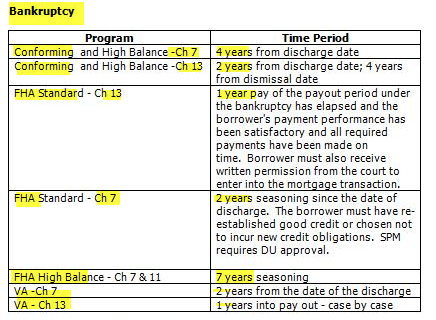
    Here are the time lines for when a buyer can purchase again after suffering a Bankruptcy and they are trying to obtain either Conventional, FHA or VA financing.

    Conventional . For a chapter 7 Bankruptcy it is 4 years and 2 years for a chapter 13 bankruptcy for Conventional financing.

    FHA. For a chapter 7 Bankruptcy it is 2 years and 1 year fora chapter 13 for FHA financing.

    VA. For a chapter 7 Bankruptcy it is 2 years, and 1 year for a chapter 13 bankruptcy for VA financing.


    Reach out to all past clients, friends and family

    As the housing crash is now in its 5th year, you will start to find that more and more buyers you talk to who did suffer a financial hardship in the past, will be getting closer to being able to qualify to purchase again. For example, as the VA only needs 2 years from a short sale or a foreclosure, and the FHA only 3 years, you may find some past clients who have already gone past these dates!
    Check the dates with any clients you helped short sale in the past, and family or friends you know who also suffered a short sale, and verify how much time has elapsed since their financial hardship, so you can let them know how soon they can re-purchase again. Do the same with past clients, friends and family who suffered a Foreclosure or Bankruptcy too, and verify the dates they suffered their financial hardship and let them know how soon they can purchase again based on these time lines above too.

    Help Buyers rebuild their credit now

    It is also important to find out if your buyer has re-established their credit again since their hardship, because even though the required time line of say 2 or 3 years may have passed for FHA financing, it is important they have started to rebuild their credit and have the required fico scores needed too. Fyi FHA and the VA only require a 620 credit score to repurchase again.

    Give them tips on how to rebuild their credit again, so they can get in a position to repurchase asap! The first step is for someone to get a copy of their credit report to verify if their financial hardship or discharge is reporting correctly and to also see what their scores are. Let your buyers know they can go to www.annualcreditreport.com to get a FREE copy of their credit report (they are allowed 1 free per year). The next step is to start rebuilding their scores,  here are 5 Quick Credit Tips that you can share that will help someone build their credit faster.

    Tomorrows Buyers

    Tomorrows buyers are the people who suffered a financial hardship in the recent past! Many of these people I talk too assume it takes anywhere from 4-7 years before they can purchase again, and a lot of them are genuinely shocked when they realize that the FHA for example allows them to purchase again after just 2-3 years!

    Start educating people now via email campaigns or facebook posts, letting all your clients, friends and family know about these time lines above in case they are unaware of the time frames necessary before they can re-purchase again. Let them know how important it is that they rebuild their credit too, and if they need credit tips on how to rebuild their credit they should contact you.

    I hope you found this information useful. If you have any questions in regards to these programs or time lines listed above, please feel free to contact me directly at 858-200-9602 or via email at mdeery@citywidefinancialcorp.com . I look forward to chatting soon.

     

    The Different Factors That Determine the Rate on a Mortgage

    February 7th, 2012

    There are many factors that determine the interest rate on your mortgage. The most frequently asked questions that buyers and homeowners ask are, What’s my rate” (even before an application is filled out), or “How is my mortgage rate determined” or “why is my rate higher than what is advertised on TV or radio? or “Do you see rates increasing when I am ready to buy in a few months?”, With these questions in mind, here is information you can use that will help you better understand the different factors that will determine the interest rate on your home loan.

    Your Credit Scores and Mortgage Rates

    It is no secret that having good credit scores are important for buyers in this market to score the best rates, and this is especially true for conventional loan rates.

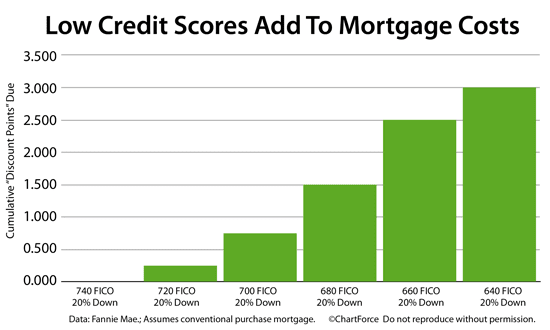
    Check out this chart below. A buyer with a 690 credit score purchasing a $400k home with 20% down, has to pay an additional 1.5 points ($4,800) to get the same rate as a buyer with a 740 score. If they choose not to pay the points, their rate will be roughly .5% higher.

    A buyer with a 660 score, has to pay 2.5 points to get the same rate as a 740 buyer, which amounts to $10k on a $400k loan.

    To maintain great credit, everyone should review a copy of their credit report once a year, so when you are ready to get financing, this will ensure you are always in a position to score the best rates. As a California resident, you are entitled to a free report once a year directly from the credit bureaus.

    I have a section on my website devoted to helping clients better understand and improve their credit scores, so they can qualify for the best interest rates. Click HERE to see this section.

    Other Factors That Determine Your Mortgage Rate

    There are several other factors that determine the interest rate on your loan. For example, the amount of equity you have in your home also determines what rate you get. A buyer putting down 40% on a home purchase will get a lower rate than someone who puts down 20%. A homeowner refinancing with 40% equity in their home will get a lower rate than someone with 10% equity in their home.

    The type of property you buy or own also determines the interest rate on your loan. For example, the rate is higher for 20% down on a condo versus 20% down on a single family residence. A good tip is to put down 25% on a condo, then the rate is the same for a condo as a single single family residence.

    The loan amount you borrow will also effect the interest rate on your loan. Rates on loans <$726k, which is the conventional loan limit, will have a lower rate than a loan >$977,500, which is considered a conventional jumbo loan.

    Each county in CA has it’s own conventional loan limit. The conventional jumbo loan limit in San Diego is $977,500 and $1,089,300 in Los Angeles.

    An investment property has a higher rate than a primary residence rate. Banks consider buying an investment property a higher risk than a primary residence, and thus price it accordingly. A down payment of 20% is also the minimum down payment for an investment property purchase.

    Borrowing cash-out on your refinance will also affect your rate. For example, someone borrowing cash-out will have a higher rate than a loan with no cash-out.

    If you want to remove the monthly mortgage insurance “PMI” from your mortgage payment, the rate will be higher than a mortgage with monthly PMI. All you have to do is take a slightly higher interest rate than normal, and we use a lender credit with the higher interest rate to eliminate the PMI from the mortgage payment. This is also known as lender paid mortgage insurance. Apples to apples the overall monthly mortgage payment with No monthly PMI will be lower than the loan with monthly PMI.

    As you can see, there are many different factors that have to be taken into consideration when determining the interest rate on your loan. There is not a one-rate-fits-all when it comes to obtaining the best interest rates on conventional financing.

    The Relationship between Mortgage Bonds & Mortgage Rates, and why Rates can change 2-3 times a day.

    The reason that mortgage rates move up or down every day, is because Mortgage Bonds (MBS) are traded everyday just like stocks. They either go up or down in price on a daily basis.

    Here is a quick synopsis of how the mortgage bond market works, so you understand how rates are determined, and so you know when is the best time to lock in your rate.

    See below a snapshot of a trading chart from a mortgage bond trading company I subscribe too. This is where we watch rates and mortgage bonds trade live each day, so we can give our clients up to the minute interest rate pricing, so they get to lock in the lowest mortgage rates possible.

    When Mortgage Bond prices are moving higher, it means home loan rates are improving and moving lower—and when Mortgage Bond prices are moving lower, home loan rates are getting worse and moving higher.  To go one step further—a red “candle” means that MBS worsened during the day, while a green “candle” means MBS improved during the day.

    Depending on how dramatic the changes are on any given day, this can cause rates to change as much as 2-3 times throughout the day, as well as on the rate sheets we start with each morning. This daily trading of mortgage bonds directly correlates to the mortgage rates we see every day from lenders.

    As bond markets are quite volatile these days, it is not unusual for mortgage rates to change 2 or 3 times in just one day. What this means is, the terms we quote in the morning may not be available in the afternoon if the mortgage bond market is trading negatively.

    This is why shopping around can hurt consumers looking for the best rates, as the rates you were quoted on one day, may not be available the next day. Please keep this in mind when reviewing rates and deciding when to lock in.

    Our goal is to give our clients the best possible rates available in the market. My company is approved with 47 different banks and lenders, and this includes the top 5 best rate lenders in the nation, so we will always have the very best rates available in the market to offer our clients.

    The Impact of Rates on Purchasing Power

    Changing mortgage rates do more to influence home affordability than changing home prices. This chart below shows the “impact of rates on buyer purchasing power and affordability.

    When rates increase by 1%, a buyer loses 10% in purchasing power. For example, see how the payment at the 5% rate on a $400k loan, is roughly the same payment as the 6% loan at $360k.

    This means a buyer who could afford a loan amount of $500k, can now afford $450k with the same mortgage payment.  Or a buyer who could afford $600k, can now afford $540k with the same mortgage payment.

    Or when rates decrease by 1%, a buyer gains 10% in purchasing power. For example, see how the payment at the 5% rate on a $360k loan, is roughly the same payment as the 4% loan at $400k.

    This means a buyer who could afford $500k, can now afford $550k with the same mortgage payment.

    Or a buyer who could afford $600k, can now afford $660k with the same mortgage payment.

    Current Mortgage Rates are Still Good Historically

    Current mortgage rates are still good when compared to historical rates. This chart below puts current mortgage rates in perspective.

    Did you know the average 30 year fixed mortgage rate over the past 40 years is roughly 8.7%, and 6.29% over the past decade.

    Compare this to current rates around 6%.

    Tips for Homeowners and Buyers

    If you are a homeowner looking to refinance your current mortgage, now is a great time to lock in a rate. You should also look into shortening the term of your loan, as many homeowners with 30 year mortgages are switching to shorter term loans.

    For example, with today’s rates, you can probably get a 25 year fixed mortgage that will allow you to keep your mortgage payment the same as your 30 year fixed payment, so you can shave some years off your mortgage.

    There are many homeowners with 30 year mortgages who are switching to shorter term loans. According to Freddie Mac, over the last quarter approximately 40% of U.S. households who did a refinance, refinanced out of the popular 30-year fixed rate mortgage, in favor of shorter loan terms offered by 15-year, 20-year and 25-year fixed-rate loans (see chart below).

    At today’s rates, homeowners with a 15-year loan term will pay 64% less mortgage interest than with a comparable 30-year loan, as a 15-year mortgage requires just $28,000 of mortgage interest per $100,000 borrowed. Whereas 30-year loans pay $81,000 per hundred-thousand dollars borrowed.

    As the payment on a 15 year mortgage is quite often too expensive for many borrowers to pay each month, a 20 year or 25 year fixed is also a great way to save interest over the term of a loan, as a 25 and 20 year payment is more affordable.

    We can even help homeowners refinance into a 27, 22 or 18-year fixed rate mortgage term too. This is called the “YOURgage” program, whereby you can choose any fixed term between 11 – 30 years on your mortgage.  This is a great option for someone who has been paying on their 30-year mortgage for a couple of years, or for someone who wants to retire in say 18 years, but do not want to start their mortgage back on a 30 year term. Click HERE for more information how to qualify.

    If you have any questions about interest rates or getting approved for financing to purchase a home, please feel free to contact me directly at 858-442-2686

    P.S. Please join my Facebook page for faster updates on any new mortgage programs that become available and other industry news.

    I look forward to chatting soon.


    The Cost of Waiting to Buy: Compare Buying With a 4% vs 5% Rate

    November 8th, 2011

    What is the cost of waiting to buy a home?” For example, lets say you can purchase a $400k home today with a rate of 4%, but you decide to wait 12 months and get a discount of $10k off the price, but rates have increased to 5%! Did you know it will now cost you $72,413 in additional payments over the life of the loan to purchase this same home? This is why it is so important that buyers fully understand “Cost vs Price”, because in terms of the “Cost” to buy a home and especially in the first time buyer price range, we are probably at or near the bottom of the market. Here is why.

    reasons-to-buy-now

    Compare buying the same property at 4% vs 5%!

    Lets take a look at a purchase scenario. In this example below, on the left hand side we have a property that you can buy today at $400k and with an interest rate of 4%, but in 12 months time you can buy the home for $390k but it will come with an interest rate of 5%. In this example, the buyer is putting down only 5% and can qualify for Conventional financing with NO Monthly Mortgage Insurance” (click here for details).

    The payment on the 4% loan is $2197 a month, whereas the payment on the 5% loan is $2363 a month. So even with the price reduction of $10k, the monthly mortgage payment on the 4% loan is still $166 less a month than the purchase at 5%.

    Savings over 15 years

    As you can see below, over the next 15 years, the total payment and interest savings amount to $47,203 on the 4% loan vs the 5% loan.

    Savings over 30 years

    Over the next 30 years, the total savings amounts to $72,413 for the 4% loan over the 5% loan. So the buyer who waited and bought the property with a 5% rate will pay an extra $72k over time for the “cost” of purchasing this same home.

    In summary, by waiting 12-18 months for prices to drop by say $10k, but if rates just increase by 1% during this time frame, a buyer will pay an extra $72k in payments and interest over 30 years to purchase this same property. Or another way to look at it is this, if the 5% buyer wants to pay back the same financing costs over the term of the loan as the 4% buyer, the price of the home would have to drop another $40k for the 5% buyer to match the same costs! This is why buyers must truly understand how “Cost vs Price” works, and that the overall cost that it takes to purchase a property is also just as important as the actual price tag of the home

    A 1% rise in rates..cuts 10% from your purchasing power

    Here is a great chart for buyers to review and understand as it shows the “impact of higher rates on payments”. As you can see below, when rates rise by just 1%, a buyer loses 10% in purchasing power.

    For example, lets say a buyer is approved for a $400k purchase at 4% (see blue shade to the bottom right), but they decide to wait for prices to drop even more. Look what happens when rates increase by just 1%, with a rate of 5%, this same buyer can now only afford a price of $360k, as their purchasing power dropped by 10% (see blue shade to the top left)!

    Many buyers today think they should wait until they are sure that prices have hit bottom. But deciding whether or not to wait should be determined by where the COST of a home is headed!

    A historical look at interest rates over the past 40 years

    It’s also important that everyone puts the current interest rate environment into perspective, because here is a chart below that shows where mortgage rates have been over the past 40 years! On average rates have been over 7.5% for over the past 40 years, today we have rates around 4%.

    There is no guarantee that interest rates are going to stay this low for too much longer, as the Federal Reserve and the government have been artificially suppressing interest rates now for over 4 years, and one day soon they will start shifting higher especially as the US economy is now starting to show signs of improvement (rates will always increase in an improving economy)


    It’s very important Buyers understand “Cost vs Price”!

    Waiting for a reduction in price is not the only way to get a great deal on a home. Too many buyers today have become fixated on finding the bottom of the market because there is too much emphasis on getting the lowest PRICE. What is just as important is factoring in the overall COST to buy a home and that includes the interest rate and financing costs.

    As shown above, when rates move higher by just 1% a buyer loses 10% in affordability, just Imagine when rates go from 4% to 6%, a buyer will lose 20% in affordability. Therefore I believe we are at or very near the bottom of the market when considering the “overall cost to finance a home”, and especially in the first time buyer market of under $350k!

    If you have any questions in regards to interest rates or getting approved for financing, please do not hesitate to contact me directly at 858-200-9602. I look forward to chatting soon.

    Own vs Rent: How Much Home Can You Purchase For $2000 a Month?

    October 12th, 2011

    Owning a home has always been the American Dream. Unfortunately the recession and bursting of the housing bubble has caused concern among home buyers. Now we have too many buyers sitting on the fence thinking renting is a better alternative to owning a home. I wanted to share with you an example of a “Rent vs Own” financial analysis report that I have been sharing with my clients recently. In this report, we will compare renting versus owning with a $2k a month payment, as well as show all the financial benefits of why owning a home is a better financial decision than renting.

    Renting versus owning

    In many parts of San Diego, I would say $2k a month is an average rent a lot of people are paying these days. So let’s take that $2k a month payment and see what you can buy with that monthly budget. We will assume the buyer only has a small down payment of 5% available. Now most people will assume that this buyer will have to go with FHA financing because of the small down payment funds available, that is not true anymore.

    For example, a buyer can now get conventional financing and pay NO mortgage insurance “MI” with only a 5% down payment, all they have to do is choose  the loan option whereby they take a slightly higher interest rate and “buyout” the mortgage insurance. This is a much cheaper alternative to a 3.5% down payment FHA loan, as FHA loans require buyers to pay really high MI payments each month. For example on a $350k purchase, a FHA buyer will pay an extra $323 a month in FHA mortgage insurance versus the 5% down conventional No mortgage insurance loan option. Now the conventional buyer can use these additional monthly savings of $323 to purchase an extra $50k in home and still have the same overall monthly payment as the FHA buyer. Here is more more information on this Conventional No MI program.


    How Much Home Can I Purchase with $2k a month?

    Here is the example of a “Rent vs Own” report below comparing renting versus owning for $2k a month. For a total monthly payment of $2k a month, a buyer will be able to purchase a property for $350k, using only a down payment of 5%, and get an interest rate of 4.375% on a conventional loan with NO PMI, and have a total PITI (Principle & Interest, property taxes & insurance) payment of $2k a month.

    As you can see above, the buyer will be able to take advantage of a tax benefit of $451 a month and also pay $448 a month towards principle, versus the renter who will receive no benefits from writing a check for $2k in rent every month.

    Rent vs Principle paid over 10 years


    In this section of the report it shows the rent versus principle paid over 10 years. You can see the buyer will have paid down the principle on his loan $67k over the next 10 years, whereas the renter has paid no principle, and in fact will pay over $274k in rent over the next 10 years.

    Net Worth in 10 years

    In this section of the report it shows the buyers net worth after just 10 years. By deciding to purchase a home, the buyer will have accumulated a net worth of $205k over 10 years from the financial benefits of home ownership. These 3 main financial benefits are, paying down the principle on the loan, substantial tax deductions at tax time, and accumulated equity gains due to appreciation on the property. Whereas the renter has a zero net worth due to no financial benefits of paying rent to the landlord over 10 years. Here is a link to view this report in full http://mcedge.tv/16a9w8 .

    It’s time to buy and not rent!

    If a buyer is one of those who is worried about prices declining further, then they should consider the following: Prices are low and rates are low. If you talk to your accountant and find out what the mortgage interest deduction and deduction for real estate taxes will do for you, you will probably find it is now cheaper to own than to rent in many areas. Because when prices decline investors rush to buy properties.  They hold on to these properties because they expect the values to increase. In the meantime they rent them out. Demand for rentals goes up when fewer owner occupant properties are sold.  As demand for rentals goes up so do the rents.

    But if you own your own home, and get a low fixed rate mortgage, your principle and interest payments are constant and will never change. The taxes and insurance usually go up, but guess what? Landlords also add this to the rental increase if you are renting.

    The clients I work with love these “Rent vs Own” reports, because it compares the financial benefits of owning versus renting and shows all the figures they need to see when when making the decision to buy a home. If you would like to see one of these reports with figures you are interested in looking at,  please feel free to contact me directly at 858-200-9602 and I would be happy to put this together for you. I look forward to chatting soon.

    How to Refinance your Home to 95% and Not Pay Any Mortgage Insurance

    September 1st, 2011

    Most homeowners today assume they cannot refinance up to say 95% of their property value because they think they do not have enough equity to do so, or if they finance over 80% of their property value the loan will automatically carry mortgage insurance. That is not the case anymore as Fannie Mae is now offering refinancing options up to 95% with No mortgage insurance or No “PMI” for homeowners.  Because of the tremendous opportunity offered by this new program, homeowners can now refinance their mortgage and obtain a interest rate below 4.5%.

    good-news-thumb181690741

    A good sign for the market

    A good sign for the housing market is that the lenders and the mortgage insurance companies are offering this program to help homeowners. I think we can look at these new refinancing options as a positive sign for our market place, as banks  and mortgage insurance companies are now willing to offer these loan programs that have been unavailable for the past few years. Let’s hope for more of these positive changes.

    imagescamcq7v2

    How does this No PMI work?

    So how does this NO MI loan work? It is quite simple. A borrower now has two choices with conventional financing up to 95%. They can either take a loan with MI at say 4.375%, or they can take a slightly higher interest rate at 4.5% and “buy out” the MI, the additional yield on the higher rate pays off the MI so now the buyer has a mortgage payment without any MI. Apples to apples, the loan with the slightly higher interest rate will carry a much lower payment than the loan with monthly mortgage insurance.

    imagescaohiin5

    I think this is one of the better loan programs out there today, as this program now allows a borrower to either #1, refinance and put additional savings back into their pocket each month, or #2 it works really well on purchase loans too, because it now allows the buyer to purchase extra home with the additional monthly savings. For example, because of the expensive MI payments that come with a FHA loan, a buyer is now able to purchase a $400k home with conventional financing with the same monthly payment as a $350k FHA purchase.


    If you are just looking to do a regular refinance and you do NOT need to take advantage of this No PMI loan program, you may be able to qualify for a 3.99% refinance with no points. Check out the savings below. Even if you have a rate at 4.75% you will save $220 a month on a $410k loan, or you can even take a 25 year fixed and still save $13 a month over your current 30 year loan at 4.75%, both of these options will save you over $125k in interest and mortgage payments.


    facebook-refinance-example1

    Let homeowners and buyers know about this program

    From the majority of people I talk to, many do not know this new program exists, so make sure to let everyone you know who is interested in refinancing or buying a home know about this program. Most homeowners automatically assume you need 20% equity to be able to refinance to get today’s record low rates, or if they don’t have 20% equity the loan will come with monthly mortgage insurance. This is not the case anymore.

    I hope you found this information useful. Feel free to contact me directly at 858-200-9602 if you want to chat about the best way to use this program to meet your refinancing goals. I Look forward to chatting soon.

    Buyers Lose 10% in Purchasing Power When Rates Increase by Just 1%

    July 15th, 2011

    Did you know that buyers lose 10% in purchasing power when interest rates increase by just 1%? With rates jumping from between 4.375% and 5% in just over the past few months, it might be fair to say that we may have hit bottom in the housing market when factoring in what the overall cost is to buy a home. As rising interest rates will eat away any savings buyers could get from waiting for prices to dip again, eventually a buyer needs to make a decision about what is most important to them, either it is their monthly payment or “finding the bottom of the market in terms of price”.

    The Impact of rising rates on affordability

    Here is a great chart below to share with buyers that shows as rates go up a buyer loses purchasing power.  As you can see, with every 1% increase in rates, the buyer loses 10% in affordability. Let’s say someone was shopping in the $400k range but rates increased suddenly by 1%, unfortunately that same buyer will now only afford a $360k price range to keep the same monthly mortgage payment.

    The impact of rising rates on buyers approvals

    Unfortunately when rates start rising again, this is going to affect a buyer’s purchasing power and monthly mortgage budget. So it is going to be very important that buyers know if they can still qualify and can afford higher rates in their budget. For example, a pre approval that the buyer has had for 3-6 months putting in offers at 4.5% that stretched their budget, might be unaffordable now because rates are at 5%. For example, on a $400k loan the payment increases $121 a month when the rate jumps from 4.5% to 5%, this is a lot for a family of 4.

    Higher rates will also affect any current purchase offers or loan approvals that buyers may have. So for someone that was shopping in the $400k range a month ago and the rate was 4.5%, that same monthly payment will only get a home for $380k now with rates at 5%. Remember also, lenders have been tightening their qualifying ratios recently and are constantly changing their rules too, so double check to make sure any increase in rates/payments do not disqualify a buyer from a certain price range either.

    Cost vs price. What is the difference?

    Buyers have a tendency to look at just the PRICE of the house instead of the overall COST to buy the home. The cost is actually more important. So what is the difference between cost vs price and why is this so important for a buyer to understand? Cost is what a buyer will pay for a home overall, including financing costs. Price is just the actual price tag the buyer will pay the seller for the home not including any financing costs.

    This is why it is so important for buyers to understand that rising rates have a tremendous impact on a buyer’s overall cost and monthly payment. We all know there are some home buyers still standing on the sidelines waiting for the prices of real estate to hit rock bottom. These are the buyers that need to understand cost vs price, once they understand this dynamic, then perhaps they will realize that now is a great time to buy a home and may make the decision to buy a home a lot sooner.

    Charting mortgage rates over the past 40 years

    Here is a great chart below to share with buyers that will give them a little history lesson on interest rates. The average interest rate over the past 40 years has been 9%! Considering the heightened volatility that exists in the financial markets today, as we have the debt ceiling fiasco in Washington, the continued debt crisis in Europe and now talk of more Federal Stimulus aka Quantitative Easing part 3 from the Feds, buyers are taking a huge gamble in assuming that interest rates will remain this low. Because honestly no one really knows where they will be in 6 months due to the unprecedented circumstances we have in today’s financial markets.


    why-rates-are-great


    But for anyone still looking at buying a home, you can let them know they can still qualify for the lowest rates in 40 years.

    Why now is the best time to buy

    Everyone wants the best possible value whenever they purchase anything. When buying real estate, the best value is not determined by price alone. Value is determined by price and overall financing costs. Buyers most take both into consideration when making the decision to purchase a home.

    If you know anyone that is considering the purchase of a home but believes that waiting is the prudent thing to do because prices may continue to soften, make sure you keep an eye on interest rates for them and have conversations regarding increasing payments and if these rising payments still fit into their mortgage budget.

    Because of low interest rates and low home prices, I believe that there has never been a better time to buy a home than today, because rising interest rates will only continue to eat away any savings they could get from waiting for prices to dip again. If you have any questions about any of the information above or you need help getting any buyers pre approved, please feel free to contact me directly at 858-200-9602. I look forward to chatting soon.


    Why Fannie Mae’s HomePath Purchase is a Great Option For Buyers

    June 29th, 2011

    There are many reasons for buyers to look at a Fannie Mae HomePath purchase in this market. For example, on a HomePath purchase there is only a 5% down payment requirement for buyers who purchase the property as their primary residence,  only 15% for investment properties, there is no appraisal required and there is no mortgage insurance on any of their loans. Here is what you need to know to qualify for a Homepath purchase and Homepath financing.

    What is HomePath and what are the benefits to buyers

    Fannie Mae at the end of last year had over 100k foreclosed properties on its books, these are all listed under HomePath, Fannie Mae’s REO division. HomePath allows a borrower to purchase these properties with a low down payment, flexible mortgage terms, no lender-requested appraisal and no mortgage insurance. Here are the main benefits for a HomePath buyer.

    1. Low down payment and flexible mortgage terms (fixed–rate, adjustable rate).
    2. Down payment (at least 5%) can be funded by the borrower’s own savings; or a gift.
    3. No appraisal required.
    4. No mortgage insurance.
    5. Only 15% down payment for investment properties.
    6. Only 660 credit scores required.
    7. Many condo project requirements are waived (*if complex has less than 51% owner occupied ratios for example).


    Comparing a HomePath Purchase vs FHA for buyers

    Check out this Homepath vs FHA $300k purchase scenario below that shows the benefits for the HomePath buyer over the FHA buyer. On the left column we have the FHA buyer who has to put down a minimum down payment of 3.5%, vs the HomePath buyer on the right who only has to put down 3%.


    As you can see above, even though the FHA buyer has a lower interest rate, the HomePath buyer has an overall lower monthly payment and will save an extra $257 a month because there is NO mortgage insurance (MI) on their loan. Also, as the HomePath buyer is getting their closing costs paid for by Fannie Mae (see incentive above) their total cash to close is just $9k, vs the cash to close of $20,895 due from the FHA buyer if they don’t get their closing costs paid for.

    Also, the longer term savings are also significant for the HomePath buyer. See below, over the next 10 years on this particular scenario, the HomePath buyer will save $33,544 vs the FHA buyer.

    We are an approved HomePath Lender

    We are an approved Homepath lender and we have been helping many buyers qualify for the HomePath loan program. If you have any HomePath questions or you would like to get approved for financing, please feel free to contact me directly at 858-200-9602. I look forward to chatting soon.


    How to Lower Your Property Tax Bill

    April 28th, 2011

    I wanted to share some information that every homeowner should know. According to an industry trade group, more than 60 percent of U.S. homes currently have their property taxes over-assessed as a result of falling home valuations and inaccurate county records. Check out this chart below, it shows that since 2006, while home values have dropped roughly 25% on average nationwide according to Case/Shiller, National property tax revenue since 2006 has increased from $375 Billion to $476 Billion or 22%. This was a cash cow for all the states during the housing boom, but they now need to reassess their taxes down to meet current housing values. Over-assessment creates a bigger annual tax bill than for which you should otherwise be responsible.


    How To Appeal Your Home’s Real Estate Taxes.

    The good news is that, in most counties, having your taxes lowered can be as simple as filling out a form and providing proof of valuation. Usually in the form of an appraisal. NBC’s The Today Show ran a piece last year that remains relevant today. It’s loaded with tips to help you drop your tax bill, most of which won’t require attorneys or other “expensive” third-parties. Here is the link to that show which will help you with these points below NBC’s The Today Show link

    * When to file your tax bill dispute for the best chances of winning
    * How to pull your “property card” and check for tax bill-raising errors
    * What to do if the taxing authority turns down your request

    Contesting your tax bill doesn’t need to be expensive or time-consuming. It just helps to be prepared. Do your research and make your case.

    Did You Know That 50% Of Tax Appeals Are Successful

    If you can win your home’s tax appeal, you stand to save good money. It’s worth the effort if your home is over-assessed. After all, it’s estimated that half of all contesting homeowners are successful with their appeals. During the appeal process, you may want a copy of your most recent home appraisal (your Loan officer or Real Estate agent should have a copy) if you had one done in the past 12 months. The more evidence you can provide, the better your chances of a good result.

    If you know of anyone else who could benefit from this property tax information, please do forward this message along. Also, if you know someone that is looking to lower their mortgage payment or is looking for financing to purchase a new home, please feel free to pass along my information or have them contact me directly at 858-200-9602.

    Why Sellers With FHA Loans Should Close at the End of the Month

    April 6th, 2011

    Did you know that if a FHA seller sells their home early in the month, they are charged interest through the rest of the month by the FHA? This is a fact that not a lot of sellers are not aware of because it is only the FHA that calculates interest on a full months basis, whereas conventional loans etc only calculate the interest through the closing date. This is why it is recommended that all sellers who have FHA loans should have their contract scheduled to close at the end of the month, so they can put as much money as possible in their pockets from the sale.

    The FHA is overcharging sellers

    Let’s say for example, a seller pays off a $400k FHA-insured mortgage on April 5th and the seller has a 5% interest rate, the seller will be charged an extra $1640 in interest to cover interest through the remainder of the month. By scheduling the contract to close at the end of the month, this will put that $1640 back in the sellers pocket.

    Quite frankly how the FHA are calculating this interest is just wrong! Many sellers today are already trying to squeeze minimal profits from their homes, and these profits are rightfully theirs. But as the Govt and FHA need every penny they can these days, this is a huge source of income for the FHA if you consider they do this on every transaction, in fact they are raking in over one Billion dollars a year alone through this program.

    Supposedly the FHA are looking into this and are exploring methods to move to a per diem method that everyone else uses, I have a feeling this “change” will probably take a while. But considering the technology that is available out there today, I am sure someone could figure this solution out with the stroke of a keyboard.

    This is why FHA homeowners who do a FHA refinance will always be advised to close at the end of the month, so they don’t get charged double interest. So make sure your FHA seller too is aware of how the FHA will calculate their payoff on their home and recommend an end of month closing, so they can put as much money in their pocket when they sell their home.

    4 Must-Ask questions for Buying or Selling a Condo with FHA

    I probably get asked the following question as much as any other question, “what are the FHA requirements for a FHA buyer to get financing on a condo”. If your client is interested in buying a condo and obtaining FHA financing, it is a good idea to make sure you have the following 4 questions answered upfront to ensure the complex will meet HUDS minimum standards and qualify for FHA financing. Otherwise it is risky going into contract and waiting for the HOA cert to come back a week or two later, because most of the time just one of these issues below may kill a transaction.

    1. Is the complex currently FHA approved? use this link to check https://entp.hud.gov/idapp/html/condlook.cfm If the complex is not FHA approved it will not qualify for FHA financing.

    2. What are the owner occupied ratios? Remember FHA needs 50% of the units to be Owner occupied!

    3. How many of the units are delinquent on their HOA dues? The majority of lenders require that less than 15% of the units be delinquent. FYI, I have a couple of lenders who will accept more than 15% HOA delinquencies as long as the other 4 questions come out positive.

    4. Is there any current litigation in the complex? FHA will not lend if there is any litigation in the complex.

    Doing the homework upfront is critical

    Getting these 4 questions answered ahead of time will save everyone a lot of time and hassle on a transaction. Many of the underwriters I talk too are advising that they are having to decline a lot of FHA files because one of these issues above pop up when the HOA cert comes in from the condo complex.

    Myself and my assistant always do as much homework as possible upfront with our condo buyers before they go into contract, as we want to make sure we have all 4 questions answered above. Doing this homework just ensures that the transaction will close escrow. There is nothing worse for everyone involved, than working on a transaction for months helping a buyer find a home and getting them into contract, only to find out a few weeks later they do not qualify for the loan.

    If you have any questions about any of this information above, please feel free to contact me directly at 858-442-2686. I look forward to chatting soon


    As Mortgage Rates Increase By 1% a Buyer Loses 10% in Affordability!

    December 15th, 2010


    With rates jumping from 4% to 5% on a home loan in just over a few months, it might be fair to say we may have hit bottom in the housing market when factoring in what the overall cost is to buy a home? Because did you know that with every 1% rise in rates, the buyer loses 10% in affordability. It is now very important that buyers understand that rising interest rates will eat away any savings they could get from waiting for prices to dip again. Eventually a buyer needs to make a decision what is most important, their monthly payment or “finding the bottom of the market in terms of price”.


    Cost vs price. What is the difference?


    A lot of buyers have a tendency to look at just the PRICE of the house instead of the overall COST to buy the home. The cost is actually more important. So what is the difference between cost vs price and why is this so important for a buyer to understand? Cost is what a buyer will pay for a home overall, including financing costs. Price is just the actual price tag the buyer will pay the seller for the home not including any financing costs. 


    This is why it is so important for buyers to understand that rising rates have a tremendous impact on a buyer’s overall cost and monthly payment. We all know there are home buyers still standing on the sidelines waiting for the prices of real estate to hit rock bottom. But buyers need to be concerned about the monthly COST as much as they are concerned about the PRICE of the home. Here is why.


    Impact of higher rates on payment

    Let’s take a look at some numbers to see what rising interest rates do to the monthly payment on a loan. Here is a great chart below that shows as the rate goes up the affordability of the buyer goes down. As you can see, with every 1% increase in rates, the buyer loses 10% in affordability.


    So lets say if someone was shopping in the $400k range a month ago because that was their maximum mortgage budget, unfortunately that same buyer will now need to be looking in the $360k price range today to keep the same monthly mortgage budget.


    Making sure buyers still qualify at higher rates

    Unfortunately higher interest rates are going to affect a buyer’s purchasing power and monthly mortgage budget. So it is going to be very important that buyers know if they can still qualify and can afford higher rates. For example, a pre approval that the buyer has had for 3-6 months putting in offers at 4% that stretched their budget, might be unaffordable now because rates are at 5%. For example, on a $400k loan the payment increases $238 a month when the rate jumps from 4% to 5%. This is almost a car payment for some families. 

    Higher rates will also affect any current purchase offers or loan approvals that buyers may have. So for someone that was shopping in the $400k range a month ago and the rate was 4%, that same monthly payment will only get a home for $360k now with rates at 5%. Remember also, lenders have been tightening their qualifying ratios recently and are constantly changing their rules, so make sure any increase in rates/payments do not disqualify a buyer from a certain price range either.


    What are rates at now? They are still at 40 year lows!


    With rates now back up to 5%, the question is where will they go from here? Well all experts are predicing they are on their way to 6% soon, as the bond markets have gone on a massive sell off since the inception of the Feds stimulus program “QE2” on November 4th 2010. I think they are probably going to a 5.25% 5.5% range over the next few months and possibly may go higher. But on a positive note, they are still at historical lows when you compare them with interest rates over the past 40 years. Here is a good chart that tracks interest rates for the past 40 years.


    So for anyone still looking at buying a home, you can let them know they can still qualify for the lowest rates in 40 years. Hopefully this will lessen the blow for those folks that did not get an opportunity to purchase when they were in the low 4% range.


    Bottom Line


    Everyone wants the best value possible whenever they purchase anything. When buying real estate, the best value is not determined by price alone. Value is determined by price and financing costs. So buyers most take both into consideration when timing their purchase.  

    If you know anyone that is considering the purchase of a home but believes that waiting is the prudent thing to do because prices may continue to soften, make sure you keep an eye on interest rates for them and have conversations regarding increasing payments and if they still fit into their mortgage budget. Otherwise all those days spent writing up approval letters and showing homes at a particular price range will be to no avail if the buyer cannot afford the new higher payment.   

    Please feel free to contact me with any questions you have. I look forward to chatting soon.