• Categories

  • 5 Practices to Avoid to Protect Your Credit Scores

    December 11th, 2010

    In today’s economic environment, more than ever are banks and credit card companies requiring stronger credit scores to qualify for mortgages, credit cards, auto loans and most forms of financing. However, some less obvious factors can still make a negative impact on your credit rating. They may seem counter-intuitive, and some may go against what you’ve been told in the past, but here are 5 practices to avoid which can cause your credit scores to drop down significantly.

    1. Settling past-due debts with a creditor to pay less than you owe.

    Anyone who has amassed enough credit card debt has gotten the pitches in the mail, and sleepless fretting debtors see the ads on late-night TV: Pay Down Your Debt! It always sounds too good to be true and it is.

    “Even though you’re getting rid of bad debt, it stays on your report as ‘settled’ rather than ‘paid off,’ and is now updated on the payment date, making it look like it happened more recently than the original loan. Your credit score is weighted more heavily toward recent events than past events, so taking a bad debt from the past and moving it to the present will count against you.”

    2. Transferring balances from a high-interest account to a low-interest account.

    Ahh, the old trick of debt-juggling from card to card. You get an offer for a new card with an enticing 0% annual percentage rate for a whole year. Who knows what might happen in that interest-free year—you could even pay off this debt for good, right?

    Balance transfers can seem like a good idea at the time, “While it’s better for your bottom line, opening new accounts works against your credit score. Plus moving all your debts to one card could negatively impact your credit utilization (your ratio of debt to available credit).”

    3. Closing old credit cards.

    One school of thought holds that the more credit you have open, the more risk that it could be misused, or it could leave you more vulnerable to fraud, so you should close your unused cards. But closing cards hurts you two ways, by increasing your debt utilization and shortening your credit history length. “Creditors like to see that you have a lot of unused, available credit, and that you have accounts that have been open for a long time without problems.”

    4. Paying off your car or your mortgage.

    What? Paying off your mortgage can work against you? “FICO reports that 10 percent of your credit score is determined by your ‘credit mix,’ and they like to see a variety of installment and revolving loans. If all you have is an auto loan and three credit cards, paying off the car will leave you with nothing but revolving credit.” However, in that case you might want to focus on paying off that debt.

    5. Avoiding debt altogether won’t help you.

    So basically, no matter what, you’re doomed! (Kidding. See the conclusion below for a glimmer of hope.) “While eschewing debt is in vogue these days, your credit score is based on how well you can handle credit, and all of your score’s components are based on you having open debt accounts,” That means that even if you are anti-credit cards, well-managed credit accounts will eventually help your case if you plan on getting a mortgage.

    It may now seem like credit scores are a hopeless “damned if you do and damned if you don’t” situation. But there are ideals you can strive for to achieve a good credit rating. Therefore, it’s pretty difficult to get penalized for having too many accounts. Here are some good parameters to work with to ensure your credit scores will always be as high as possible.

    1. The ideal number of loans or credit lines is 6-21
    2. The ideal number of credit inquiries is 0-4 in the last 6 months.
    3. A 5+ year credit history is ideal.
    4. 5% to 85% credit line utilization is ideal.

    I hope you found this information useful. If you are looking for some fast and easy ways to help improve your current credit scores, click HERE for 5 tips that you can use right away to give your credit scores a boost. As always feel free to contact me with any questions you have.


    New Rules Force Lenders to Check Buyers Credit 120 Days Back

    September 7th, 2010


    It has been described as a “financial colonoscopy” on your credit! Fannie Mae and Freddie Mac are now requiring lenders to recheck and review a borrower’s credit profile after they have been approved for a mortgage but haven’t yet gone to closing. That period can extend back as far as 120 days. If any new credit “inquiries” or new debts pop up on the borrower’s credit file during this time, lenders must check them out to determine whether any new debt might require a re-underwriting of the originally approved and quoted terms. Underwriters have been advising that some transactions have been having problems right at the funding process, because borrowers are not being coached properly before or during the loan process about this new rule.

      credit-score1  

    Buyers need to be informed correctly about their credit


    Freddie Mac’s new 120-day look-back rule on inquiries is designed to turn up situations where home buyers apply for credit a couple of months before seeking a mortgage but the inquiry and new account haven’t hit the national bureau files because of differing reporting schedules followed by creditors. By scanning back 120 days — the previous standard was 60-90 days — virtually all inquiries made during the four months preceding the application should show up. If they’re not caught then, they are certain to be spotted during the scans or refresher reports obtained before closing.


    This current economic crisis has created even tougher guidelines and credit requirements for borrowers, and there are some things that consumers must be aware of when they are in the process of getting their loan. Here is a list of 4 Credit do’s and don’ts during the loan process to use as a reference, so borrowers can fully understand just what they should and should not do before or during their loan process, as some of these things can unknowingly wreak havoc on a transaction.


    4 Don’ts to adhere to until the loan funds


    1. Don’t Apply for new credit until the loan funds


    Many borrowers still think it is OK to apply for lines of credit or credit cards during the loan process because they will need more available money upon the closing of their loan to furnish the home etc. Applying for credit cards can cause a borrowers credit score to drop if they apply for several different cards or allow their credit to be pulled by different credit card companies. So the simple solution is to advise the borrower not to apply for anything until after closing.


    2. Don’tAllow multiple credit checks  

    Borrowers should not be having multiple credit checks pulled by different lenders. I have heard recently of borrowers allowing other lenders to pull their credit a few weeks into the transaction because someone else said they could get a lower rate, and they even had their rate locked at another lender. Once a borrower has given a lender commitment and especially after a loan is locked, they need to stick with that lender. 

    3. Don’t “Shop” for new credit before closing (Furniture, cars, etc) 

    Borrowers need to know that it is not “ok” to shop for credit or buy any new furniture before closing. Many will be excited to go to Jerome’s etc and pick out new furniture for their new home and then get talked into allowing their credit to be pulled by some salesman, because he told them if they apply today they will qualify at 0% interest for 5 years. Picking out the furniture etc is fine, but they will need to qualify for the actual purchase after the loan has funded. Once again this can cause a borrower’s credit score to drop and affect their funding.   

    4. Don’t dispute anything on a credit report   

    Did you know that Fannie Mae and FHA have a new rule whereby they cannot fund a loan if there is a disputed account on a borrower’s credit report, even if this is a $10 medical bill charge. If a borrower needs to dispute something, they need to do this after the loan funds. If they plan on paying or settling  collection accounts they need to do this after funding otherwise this can cause the credit scores to drop.


    4 Do’s to adhere to before loan funding  


    1. Do Disclose all Debt—even if it did not show up on your credit report 

    Many times underwriters will find additional debt a borrower did not disclose on their application. Perhaps they just bought a car or a jet ski but the payment does not show up on their credit yet. Or they took out a loan against their 401k and it just popped up at closing on their pay stub. These new payments could easily ruin a borrowers closing once it is factored into their debt to income ratios and suddenly they don’t qualify anymore.   

    2. DoExplain or document all inquiries on your credit report 

    Borrowers need to explain or document everything that pops up on their credit report profile. Write letters of explanation for any inquiries that occurred during the loan process. If they were inquiries because they were shopping for a mortgage loan then have this written in a letter to the underwriter. If there was an inquiry at Jerome’s and they were just “shopping for credit” and did not buy anything, make sure they tell the underwriter that they did NOT purchase anything. If they did buy something they need to disclose this, because the underwriter will find out.

    3DoCommunicate everything with your loan officer and agent 

    Borrowers must understand that they need to communicate everything to their loan professional and Real Estate Agent if it relates to their finances. For example a borrower maybe embarrassed to talk about an emergency loan they had to give a family member and they used a cash advance to give the cash to the family member, then the underwriter pulls their credit before closing and finds a new charge of $5k on their Chase card. If this is disclosed upfront then we have time to factor this into their loan ratios and determine if the loan will still qualify.   

    4. Do Pay all bills on time and follow up for confirmation

    This is an obvious one, but extra care should be taken to make sure all bills are paid on time during closing and also followed up on to make sure the payments were received and processed on time. Sometimes a creditor may not have received their check in the mail or posted the payment late. I had a client who had not missed a mortgage payment in 7 years and was buying an investment property a few months ago, the lender never got the check and posted a 30 day late on her credit..it only showed up on the lenders credit because my credit was from the previous month, needless to say the loan died.


    Providing a Do’s & Don’ts credit checklist upfront   

    In today’s loan process, extra attention needs to be given to a borrowers credit to ensure they understand the ramifications of their actions during the loan process. To make sure my clients are getting coached correctly and are held accountable, I hand out a “Do’s and Don’ts checklist” at the beginning of the application process that clients are told to follow until their loan funds. This ensures that they fully understand what they need to do to make sure their loan funds, and that the funding of the loan is also in their hands and that they are to be held accountable for their own actions and their credit. 


    I hope you found the information useful in this article. Feel free to contact me directly at 858-200-9602 if you have any questions or run into any problems with any of these issues above. I look forward to chatting soon.


    How to Improve Your Credit and Score Lower Interest Rates!

    July 20th, 2010

    Figures provided by FICO Inc. show that 25% of consumers (about 43 million people) now have a credit score of 599 or below, making them a big risk for lenders. This number is up from the historical norm of 15%. At the other end, interestingly, the number of consumers who have a top score of 800 or above has increased in recent years – mostly attributed to them cutting spending and paying down debt. Here are 5 great strategies below that you can utilize right away to give your score a little boost, as this will ultimately get you a lower interest rate and save more money on any purchases you need to borrow or finance.

    Falling Credit in the US
     
    Here is a chart below that shows how credit in the US was before the great recession and after the great recession.

    Many people had their credit profiles affected by the financial crisis in the US from 2007 to 2010. With mortgages getting tougher to qualify for and underwriting guidelines requiring higher credit scores, understanding how credit scoring works is something that consumers must learn about, so they qualify for financing to purchase a home.

    Your Credit Scores and Mortgage Rates
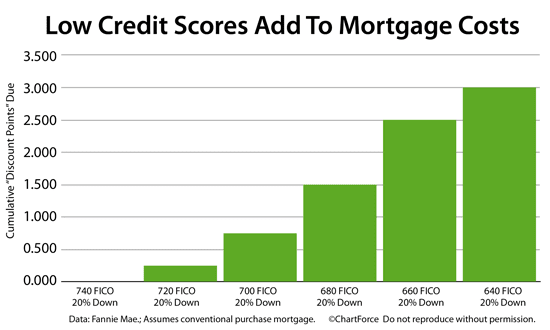
    It is no secret that having good credit scores are important for buyers in this market to score the best rates, and this is especially true for conventional rates. For example, check out this chart below, a buyer with a 690 credit score purchasing a $400k home with 20% down, has to pay an additional 1.5 points ($4,800) to get the same rate as a buyer with a 740 score, or if they choose not to pay the points, instead they have to take a .375% higher interest rate (which will incorporate these points).


    A buyer with a 660 score, has to pay 2.5 points to get the same rate as a 740 buyer, which amounts to $10k on a $400k loan. So having good scores is important to score the best rates on conventional financing.

    To maintain great credit, everyone should review a copy of their credit report once a year, so when you are ready to get financing, this will ensure you are always in a position to score the best rates. As a California resident, you are entitled to a free report once a year.

    I have a section on my website devoted to helping consumers and borrowers understand credit scoring, so they can improve their credit scores and get the best interest rates, see HERE to review this section.

    5 ways to increase your credit score-and fast

    Here are 5 great strategies that you can utilize right away to give your score a little boost..

    1. Get Your Report.

    The three main credit bureaus, Equifax, Experian®, and TransUnion®, are required by law to provide you with a free copy of your credit report once every 12 months. To request your free copy (one from each company) visit AnnualCreditReport.com or call 1-877-322-8228. (Note: free credit reports do not include credit scores.

    Scores can either be purchased on-line or pulled by your mortgage professional.) While you’re on-line, be sure to visit www.optoutprescreen.com as well. This will help you “opt out” of all the junk mail you get in the mail, credit experts advise this will give your score a boost immediately.

    2. Create Some Balance:

    The trick is to get and keep your balances below 30% of your credit limit on each card. Remember, if you pay off any credit cards completely, do not close your accounts without discussing it with your mortgage professional first. Canceling those cards may inadvertently undo all of your hard work.

    3. Know your limits:

    Make sure that your credit card issuers are reporting the correct limits on your accounts to the three major credit bureaus. Without an available limit, your account will appear to be maxed out at its highest reported balance each month. This could cost you up to 80 points in certain instances.

    Also, if you’re in very good standing, ask your creditor for a lower rate or higher credit limit. This will increase the gap in the debt you owe versus the credit you have available. Sometimes hinting about closing an account can suddenly bring out the generous spirit of certain card issuers. Give it a try. The worst they can say is no.

    4. Protect Your Interests:

    Your credit is calculated based solely on the information available to your creditors. If you have a HELOC, make sure it’s listed as a mortgage or an installment account on your credit reports and not a revolving debt. If you had a bankruptcy, be sure that all items associated with the bankruptcy are being reported correctly, that is with a zero balance. This action could increase your score by 50-100 points. Because simple mistakes like these can wreak havoc on your credit score, it’s important to monitor your credit every four to six months.

     5. Even the Score:

    If you find information on your credit report that you believe is inaccurate or incomplete, then you have the right to dispute it free of charge. For the fastest results, visit the appropriate credit bureau’s website and file a complaint on-line. If supporting documents are necessary, you have to file your dispute by mail.

    Educating consumers about credit scoring

    As you can see above, a small increase in credit scores from 700 to 740 can save someone $4,500k on a $300k purchase loan and get them a lower rate. I think it is important that consumers understand and learn about credit, so they have the opportunity to score the lowest rates when they are looking to borrow money and finance purchases.

    One of the tools we can use is the “credit analyzer” system which our credit company offers for our clients, this predictive credit scoring system will allow you to see how high credit scores can go if certain actions are taken in regards to credit, so this way a potential buyer has a definite plan of action to improve their credit scores to meet the qualifications needed for a loan. The credit analyzer truly is a fantastic tool as it accurately predicts future credit scores using the same algorithms used in credit scoring.

    If you know of anyone that needs a little help improving their credit scores so they can qualify for a loan or they need help getting pointed in the right direction to repair their credit, feel free to contact me at 858-442-2686 with any questions you have. I look forward to chatting soon.

    Compare the Savings on a 20 Year Loan vs a 30 Year Loan!

    June 10th, 2010
    There has never been a better time than now, for new buyers and existing homeowners to take a reduced term mortgage that will set them up to be mortgage free for an earlier retirement. Because of plummeting mortgage rates the 20 year fixed loan is now at 4.375% and the 15 year fixed is available around 3.99%.  Today’s record low interest rate environment is presenting just that opportunity.  
     
    Look at options to a 30 year loan
     
    I would say because of the really low rates recently, almost 40% of my clients have been taking reduced term mortgages in the past couple of months. The 20 fixed loan has been the loan of choice, as it has an affordable payment payment for a lot more clients with rates being so low. The 15 year fixed payment is usually just a little too high for all first time buyers. The idea of being mortgage free in 20 years and saving more than a $100k in mortgage payments and interest compared to a 30 year loan, is now becoming very appealing to a lot of buyers, as it opens up a whole new door of opportunities for retiring earlier. 
     
    Educating homeowners with more options 
     
    I believe that now more than ever, we must be ready to take the time to truly teach people what is happening in the market and why it is happening. Then, and only then, can they truly make the right decisions for themselves and their families. Its important to show buyers and homeowners why record low rates are presenting the opportunity of a lifetime to get a shorter term loan that will enable them to save more money and help them achieve their retirement goals a lot earlier. 
     
    Compare the Savings on a 20 Year Loan vs a 30 Year Loan!
    Here is a great example that compares the total savings on a 20 year fixed loan versus a 30 year fixed loan. For this particular example, let’s take a $400k 30 year fixed loan at 4.875% and a 20 year fixed loan at 4.375%. The difference in payment is only $387 a month more for the 20 year fixed loan. I know this will be too much for some people, but it will also be affordable to a lot of people too.


    Now lets compare the total mortgage savings on the 20 year fixed versus the 30 year fixed loan, as you can see below the 20 year loan will save $161,175 in mortgage payments and interest over the 30 year loan. (See Net Savings)
     
    Now lets see what the balance of each loan will be after 10 and 20 years. As you can see after 10 years, the 20 year fixed loan has already paid down an extra $81,147 in principle. Now let’s look at the balances after 20 years…on the 20 year fixed the balance is $0, whereas the loan balance after 20 years on the 30 year fixed is still $200,732.
     
     
    So the two huge benefits here are #1 the borrower will payoff his home 10 years early and get to retire earlier, #2 the borrower will save over $161k in mortgage payments and interest.
     
    Chat to family and friends about a 20 year loan?
     
    A recent Wall St Journal article noted that 50% of US households have an interest rate over 5.75% on a 30 year fixed loan. Have a chat with your friends and family and ask them if they have a rate this high, or if they would be interested in looking at a reduced term 20 year fixed loan and becoming mortgage free for an earlier retirement? 
     
    You can let them know that if they qualify, they would be able to refinance into a 20 year fixed loan at 4.375% or a 15 year fixed as low as 3.99%. I would be happy to help out any friends or family you have and present the figures to them as shown above, so they can make an informed decision about their future goals. As these record low rates really present an opportunity of a lifetime for many homeowners and buyers who can now look to achieve retirement goals a lot earlier.
     
    An update on mortgage rates 
     
    Mortgage rates are still edging downwards as investor cash continues to pour into the US bond market from around the world. Mortgage bonds actually had their new “price record” (highest yields on record) on Monday the 7th of June when the Fannie Mae 4.5% coupon priced out at 103.00 (see trading chart below). What does this mean to consumers? It means that if these yields stay around this high 103.00 range for the next few weeks or so, and this becomes a solid new trading range, lenders might be offering 4.5% 30 year fixed rates across the board very soon. What a fantastic opportunity this would be for new buyers and current homeowners who can refinance. 
     
     
    BUT also do not discount rates spiking up either as we are in a very volatile market right now. It is the Euro crisis that is driving everything lower including the US stock markets..Remember when stocks go down, this causes bonds to up and mortgage rates rates in turn go down. But if the Euro crisis starts to dissipate fast and the “flight to safety” of investor money to the US markets alleviates, then we will see rates rise fast.
     
    Personally I don’t see rates moving too much higher than they currently are for a few months or maybe even longer, as the member countries in the Euro zone are only starting to acknowledge and realize that severe austerity measures need to be initiated immediately in most countries. This will be a long drawn out and painful process for many countries, as evidenced by the recent riots in Greece and current union strikes in Spain. So in summary, while the Euro zone continues to have problems, this will keep money flowing to the US bond and treasury markets, thus keeping US mortgage rates low and the US stock markets lower too. But when you hear that the Euro zone is starting to get its house in order, watch this as a key factor for rates to rise and US stocks to improve again.  
     
    If you have any questions about any of the information above, please do not hesitate to contact me directly at 858-200-9602. I look forward to chatting soon.