• Categories

  • Buy a Home With Only 3% Down Conventional Financing and No Monthly PMI

    April 15th, 2013

    The conventional 3% down mortgage is the best low down payment financing option available for homebuyers in today’s market. You can also remove the monthly mortgage insurance “PMI” from the mortgage payment so you can obtain an even lower monthly payment. This Conventional 3% down program is a great alternative to FHA financing, as there is no option to remove the monthly FHA monthly mortgage insurance from the mortgage payment. Homeowners can also use this program to refinance up to 97% of their property value with No monthly PMI. Here is how to qualify for this program.

    The Benefits of a 3% Down Mortgage With No PMI – The Best Low Down Payment Mortgage Available to Buyers

    The conventional 3% down mortgage is helping many buyers obtain home ownership, who may have not been able to otherwise.

    I hear all the time from buyers who tell me they assumed they needed to save up 20% to buy a home without monthly mortgage insurance. They are excited when I tell them they only need 3% down to remove the monthly PMI.

    Being able to remove the monthly PMI is helping buyers obtain a lower monthly payment, and is helping alleviate the fears of having to take a loan with monthly mortgage insurance.

    If you know someone who is postponing a purchase to save more money, let them know about this program.

    This program also allows ALL of the down payment and closing costs to be gifted, so buyers can reach out for a gift instead of having to wait and save up the full 3% down payment.

    Fannie Mae recently increased the debt to income ratio requirements to 50%, so more buyers are able to qualify for this program now

    Let’s compare the conventional 3% down mortgage with No PMI to other low down payment options, which require monthly mortgage insurance to purchase a home.

    Compare The Savings on a $465k Home Purchase with No Monthly PMI, vs a Mortgage With Monthly PMI

    On this $465k home purchase example, we will compare the savings on a conventional 3% down loan, with and without monthly mortgage insurance, and a FHA 3.5% down loan with monthly mortgage insurance.

    To calculate property taxes, we will also use 1.2% of the purchase price, so $465 a month, and $60 a month for a homeowner’s insurance policy, so we can calculate what the total monthly PITI (principal and interest, taxes and insurance) payment is for each scenario.

    Option #1. The figures on the first column is a conventional 3% down loan with No PMI. The approximate rate on a conventional 30 year fixed with No PMI is 4.875%. The total monthly PITI payment is $2,911.

    Option #2. The figures on the second column, is a conventional 3% down loan with PMI. The rate on a conventional 30 year fixed with monthly mortgage insurance is lower at 4.625%, but there is also monthly mortgage insurance of $263 that is included in the monthly mortgage payment. The total monthly PITI payment is $3,107.

    Option #3. The figures on the third column, is a FHA 3.5% down loan with monthly mortgage insurance. The rate on a FHA 30 year fixed is 4.375%, but there is also monthly FHA mortgage insurance of $315. There is also a FHA funding fee of 1.75% due on all FHA loans, this fee of $7,852 was added to the loan amount in this example. The total FHA monthly PITI payment is $3,120.

    As you can below, option #1 with the conventional loan and No PMI will help you obtain the lowest monthly payment and save you the most money. It will save you $195 a month over the conventional loan with PMI, and saves $208 over the FHA loan.

    Over the next 15 years the conventional loan with no PMI will save $15,604 over the conventional loan with PMI, and $27,693 over the FHA loan

    In Summary. Instead of taking the conventional or FHA loan option and paying the mortgage insurance each month, the conventional loan with No PMI will give the buyer the lowest monthly payment.

    Important to remember with FHA, if you put down less than 10% with FHA, you have to pay the monthly mortgage insurance for the life of the loan. Click HERE for a summary of the current FHA mortgage insurance rules.

    Frequently Asked Questions for the Conventional 3% Down Mortgage

    Here are the most frequently asked questions that buyers and real estate agents have in regards to the conventional 3% down No PMI loan option.

    1. What is the maximum loan amount I can borrow with 3% down?

    The maximum loan with 3% down is $453,100, which is the conventional loan limit. If you need to finance over $453,100, the minimum down payment is 5%.

    This No PMI option is also available with 5% down financing on conventional jumbo loans. For example, in San Diego a buyer can finance a jumbo loan up to $649,650 and only put down 5% to eliminate the PMI. In Orange County and Los Angeles County you can finance a loan up to $679,650 and only put down 5% to eliminate the monthly PMI, which are the Fannie Mae jumbo loan limits for these respective counties. Click HERE for more information how to qualify for the 5% down Conventional loan with No PMI.

    2. Can I receive the 3% down payment as a gift?

    Yes, all of the 3% down payment can be gifted. Closing costs and reserves can also be gifted if needed.

    3. What credit score is required to qualify for this program?

    We only require a 620 credit score to qualify for conventional financing. You need a score 700 to remove the PMI. Please note, the lower the credit scores the higher the interest rate will be.

    4. How do you eliminate the monthly mortgage insurance “PMI’ option on this program?

    It’s very simple. All you have to do is take a slightly higher interest rate than normal, say from 4.625% to 4.875%, and we use a lender credit with the higher interest rate to eliminate the PMI from the mortgage payment. This is also known as lender paid mortgage insurance.

    5.  Can I get 3% down with No PMI on 2nd homes or Investment Properties?

    No, the 3% down is for Primary Residences only. On 2nd homes, you only have to put down 10% to obtain the No PMI payment option. On investment properties this program is not available, as you have to put down 20%, which eliminates the Mortgage insurance anyway.

    6. Are co signers allowed on this program?

    Yes co-signers are allowed on this program, the co-signer does NOT have to reside in the home.

    7. Is this program for first time buyers only?

    No this program is available to all home buyers.

    8. Are there income limits for this program?

    No, any buyer can qualify for this program regardless of income.

    9. Do condos qualify for this program?

    Yes, you can also purchase a condo using this program with only 3% down and get the No PMI option.

    10. Can I use an adjustable-rate mortgage with the 3% down mortgage?

    No, the 3% down mortgage requires a 30-year fixed rate mortgage only.

    11. What is the maximum number of units for a home with the 3% down payment mortgage?

    The 3 percent down mortgage is for single-unit homes only. This includes single-family detached homes and single-family attached homes such as condominiums and town homes. 2-unit homes, 3-unit homes, and 4-unit homes cannot be financed with the conventional 3% down mortgage.

    12. But FHA mortgage rates are lower than this program?

    Yes FHA interest rates are lower, but when you factor in the very expensive FHA monthly mortgage insurance, the FHA overall monthly payment will always be higher than this 3% down No PMI option.

    13. What if i put down 5% or 10%, will I get a lower rate?

    Yes, if you put down 5% or 10% for the down payment, you will get a lower interest rate. The larger the down payment, the lower the interest rate you will get with conventional financing.

    4 Other Reasons the Conventional 3% Down Program Will Benefit Buyers vs Using FHA financing

    There are some other great benefits to using this conventional program with no monthly mortgage insurance vs FHA  financing, so you have have more available homes to choose from.

    1. This conventional program is a great option for buyers in complexes that are NON FHA approved, so now you have more inventory to choose from and agents have more homes to show them!

    2. This conventional program will help you afford to purchase a single family home instead of a condo, as it frees up having to pay monthly mortgage insurance and HOA dues, which can amount to roughly $600-$700 a month on a typical condo. This will open up a lot more inventory you to purchase.

    3. Conventional does NOT have an anti-home flipping policy, which means conventional buyers are allowed to purchase homes that are being fixed up and flipped by investors with less restrictions. So now you don’t have to worry about the FHA’s strict anti-home flipping policies either, which requires that you cannot go into contract for 90 days on a home that was flipped. 

    4. Compared to conventional financing, FHA appraisals can be a little more strict in terms of asking sellers for repairs on a property, so this is another benefit of going conventional.

    It is important to get creative to find a home and get into contract these days, and this 3% down conventional program is one way to help you do that!

    *Refinance Tip For homeowners –  Refinance up to 97% of Your Property Value with No PMI

    This 3% down conventional program also works the same for refinances, as homeowners with limited equity can now refinance up to 97% of their home without having to pay any monthly mortgage insurance.

    For example, many homeowners who bought a home over the past 12-24 months using a FHA loan and a minimum down payment of 3.5%, have probably gained at least 8%-12% equity again due to appreciation. So this 3% down conventional loan program is a great option to help them refinance out of their current loan with mortgage insurance, and into this conventional loan option with No PMI, so they can save some extra money and get a lower monthly payment.

    We have been able to help many of our clients who bought over the past few years with FHA, refinance into conventional programs with limited equity and No PMI, and save on average $200-$300 a month.

    If you would like to get approved for this program, or you have any questions about any of this information above, please feel free to contact me directly at 858-442-2686. I look forward to chatting soon.

    7 Tips to Help Get Your Purchase Offer Accepted

    March 5th, 2013

    In today’s competitive housing market where multiple offers are the norm, it is very important that a buyer’s offer stands out from the crowd. Home buyers and Realtors have to get creative with their offers and also provide full transparency upfront, so the seller will feel comfortable that a buyer will be able to obtain financing and close escrow. Here are 7 tips that will help your purchase offer stand out from the crowd and get accepted.

    1. Include a Personal Cover Letter From the Buyer

    A great idea in this competitive market, is to include a personal cover letter with your purchase offer, that introduces your family and why you are the right candidate to purchase the home. Also include a family picture too.

    If you can tug at the heart strings of the seller, they may be more inclined to choose your offer over others. Many agents and buyers tell me this strategy works!

    2. Your Loan Approval Letter Verifies Your Type of Financing

    Include a loan approval letter that clearly explains what type of financing you are getting and how much of a down payment you are applying towards the transaction. For example, if a buyer is qualified for conventional financing and is putting down 20%, make sure to write this into the loan approval letter, as this will usually place ahead of a FHA buyer that has a 3.5% down payment or a VA purchase offer that has no down payment.

    If a buyer is submitting a FHA or a VA offer and is using a limited or no down payment, make sure to follow the rest of these steps below to strengthen the buyers offer, so it has a better chance of standing up against the conventional offer with 20% down.

    3. Include a DU Underwriting Approval With The Offer

    Always include a DU underwriting approval with your offer. A DU (desktop) underwriting approval is when the buyers loan application and credit report has been approved by Fannie Mae’s, FHA’s or VA’s underwriting system.

    A DU underwriting approval displays the most important information on a buyers profile, which gives the seller a good idea of the strength of the buyer. For example, a DU approval lists the buyers credit scores, debt to income ratios, assets, reserves, down payment and the type of loan program they are approved for. 

    This is a great tool to discuss the strengths of the buyers profile with the seller, so they can see how well qualified the buyer is.

    Make sure the loan approval terms on the DU underwriting approval match up with the loan program that is listed on the buyers loan approval letter, (see # 2 above).

    4. Provide Proof of Down Payment Funds

    Always include proof of down payment funds with your purchase offer. Make sure the name on the bank statements, or any other account being used for the down payment, matches the buyers name on the contract and approval, and also verify there are enough funds in the statements to cover the down payment listed on the offer.

    Or, if a buyer is getting a gift from a family member, provide a gift letter and proof of funds from the donor. Many of the offers I review do not have proof of funds provided, or there are not enough funds to cover a 20% down payment and reserves for example, so make sure there is always enough funds to cover the terms on the buyers approval.

    5. Increase your Deposit

    Want to show a seller how serious your offer is? Consider putting down a bigger deposit in earnest money. This may seem risky for some, but earnest money is there for a reason. If you are uncertain about putting a “noticeable” amount of earnest money on the table, it may be a sign to the seller that you are uncertain about the house itself.

    Assuming you hold up your end of the bargain and you have the right contingencies in place, it won’t cost you any more in the long run since the deposit goes towards your down payment if financing is involved.

    6. Be flexible and don’t ask the seller for credits to cover closing costs

    It’s a good idea to ask the seller’s agent upfront what you can do to make the offer more enticing to the sellers. Can you be flexible on the closing date for the seller?

    Also, a purchase offer asking for seller credits to pay for your closing costs will usually place behind an offer that does NOT ask for any seller credits. Some people assume just because a buyer does not have funds for closing costs, to just ask the seller to cover them.

    SOLUTION: To make a buyers offer more competitive, the lender can pay for ALL the buyers closing costs with a lender credit. How does this work? It’s easy, instead of taking say a 3.875% 30 year fixed rate, just take a slightly higher rate of 4.25% instead, and now there is a lender credit of roughly 2.5% available that can be used to pay ALL a buyers closing costs.

    Not only is this a good negotiating tactic, but of course it saves a buyer money too. We present this option to all our buyers.

    Another Tip, is to offer to pay for the sellers Owners title policy and transfer tax, these fees amount to roughly $2,500 on a $400k home, so this is another way to sweeten the deal for the seller to accept your offer. If the buyer does not have the funds, e can also pay for these fees with a lender credit.

    7. Close the Transaction Faster

    Being able to close a transaction faster is another way to entice the seller to accept your offer in this competitive market. For example, if a seller is reviewing 3 offers, and there is a 17 day offer, a 30 day and 45 day offer, usually the seller will take the fastest closing.

    My company can close a Conventional, FHA or VA Purchase Transaction in 21 days, and even 17 days if a major rush is needed. I have an outstanding team set up with 2 assistants dedicated to help close transactions fast!

    I hope you found these tips useful. I help review loan approval letters and offers every week with my Realtor partners, which is a great opportunity to look at the different types of offers that buyers are submitting in this current market. The majority of offers I review usually only have 2-3 of these items above provided.

    I believe full transparency upfront is the key to getting an offer accepted these days, because usually the Path of Least Resistance is what we look for when reviewing offers! As many times the offer that is presented the clearest, is flexible and addresses any issues upfront, is the offer that stands a better chance of getting accepted.

    P.S. If you would like to be updated faster on important industry news or any new loan programs that come out, please join my Facebook page .

    FHA Buyers Pay Mortgage Insurance for Life of Loan Starting June 3rd 2013

    December 5th, 2012

    Its official, the FHA have confirmed that FHA buyers will pay Mortgage Insurance for the Life of the Loan starting June 3rd 2013!  The FHA confirmed these changes in a press release January 30th. This will dramatically increase the cost of  FHA loans for consumers, as new buyers will pay FHA Mortgage Insurance Premiums or “MIP” for the life of the loan now rather than under current rules, whereby if the FHA borrower reaches 22% equity and a minimum of 5 years in the loan, they can remove the MIP.

    FHA Buyers to Pay MIP for Life of Loan 

    So why is the FHA doing this? The FHA is going to help its bottom line and long term solvency by making 3 new changes to their current rules to increase revenue!

    1. They are increasing monthly mortgage insurance payments again, this time by .10 basis points, so on a $400k mortgage that is an increase of $40 a month. This goes into effect on April 1st.

    2. FHA will propose an increase in the minimum down payments for jumbo loans from 3.5% to 5%.

    3. The FHA is eliminating MIP removal on loans where a buyer puts down less than 10%, so new buyers will pay FHA “MIP” for the life of the loan now. For loans in which the loan-to-value begins at 90%  or less, mortgage insurance premiums must be paid for 11 years, up from 5 years previously.

    Here is a chart that breaks down the current MIP rules versus the new FHA MIP rules. Any buyer putting down less than 10% (which the majority of FHA buyers do and why they use FHA in the first place) will pay this MIP now for the life of the loan.

    You can read the rest of the FHA press release HERE released January 30th.

    A Better Low Down Payment Alternative Than FHA

    Because of this drastic change by the FHA in regards to paying MI for the life of the loan, never more than now do buyers need to look at low down payment alternatives to FHA financing. The best low down payment option available to buyers in this market right now, is the “3% or 5% Down Conventional Loan Program With NO Monthly Mortgage Insurance”. This is a terrific purchase option for buyers, as they can finance a home with a low down payment and they do NOT have to pay monthly mortgage insurance.

    Here is a scenario below that compares a buyer purchasing a $400k home using the “Conventional 5% Down NO MI Purchase Option”, vs FHA with 3.5% down. On the left column is the conventional option. The buyer has a loan of $380k (5% down), and gets a rate of 3.75% on a 30 year fixed. The buyers total PITI (principle and interest, taxes and insurance) payment is $2,176 a month.

    On the right side is the FHA option. The buyer has a loan of $386k (3.5% down) and gets a rate of 3.5% on a 30 year fixed. The buyers total PITI payment is $2,552 a month, which is an increase of $376 a month and $35k over the next 10 years!

    Compare the savings on a $400k Conventional Purchase vs FHA

    Over the next 10 years the conventional buyer saves $376 a month and $35k vs the FHA buyer. You can see below just how much more in interest and mortgage insurance the FHA buyer will pay in total over the next 10 years, compared to the conventional buyer.

    In Summary. Instead of buyers going with FHA financing and paying the expensive mortgage insurance each month which will last the life of the loan, buyers should look into this 3% or 5% down conventional loan option to save extra money each month and over the life of their loan. As you can see above, the monthly savings are significant when choosing to finance their home with the conventional program, and buyers can turn around and put the extra savings into a college fund for their kids, or retirement, or back into the loan to pay it down faster.


    A Good Reason to Buy a Home Soon

    If you are an FHA buyer that is looking to buy soon or who have been on the fence about buying, it would be a good idea to get into contract as soon as possible, so you can qualify under the current FHA mortgage insurance rules. Or if you have not looked into it yet, you should also learn more about the “3% or 5% Down Conventional Loan Program With NO Monthly Mortgage Insurance” to see if you can qualify. For a list of frequently asked questions that buyers have in regards to the Conventional 3% or 5% down NO MI loan option, see HERE

    If you have any questions about these new FHA changes, or how to qualify for this Conventional 3% or 5% down program, please feel free to contact me directly at 858-200-9602.

    Bi-Weekly Mortgage Payments Will Help You Payoff Your Mortgage Faster

    November 22nd, 2012

    The Bi-Weekly Payment Plan is a convenient mortgage budgeting plan that can help you save thousands of dollars in interest and pay off your mortgage sooner. The biweekly mortgage payment plan is pretty easy to set up, as there are 3 different ways to make payments that will accomplish the same result.

    Typical Mortgage = 12 Payments Per Year

    The typical mortgage asks for one payment per month, which equals 12 payments per year. With a 30-year fixed rate mortgage, therefore, 360 payments are required to pay the loan in full. Each mortgage payment is split into two parts — a principal portion and an interest portion. The principal portion is applied to the amount that you owe the bank. This diminishes your remaining loan balance. The interest portion is your cost for borrowing from the bank.

    As your loan moves toward maturity, the balance between your mortgage payments’ principal-and-interest shifts. In the early years, a significant portion of your payment is comprised of interest and just a small part goes to paying down your balance. It’s not until later in your loan’s life cycle does the principal portion of the payment start to grow.


    Bi-Weekly Mortgage Payments = 13 Payments Per Year

    Here is the first way to make bi-weekly payments on your mortgage.

    1. A bi-weekly mortgage payment program is meant to short-circuit your loan’s amortization schedule. Instead of taking 12 payments per year, the bi-weekly payment plan asks for one payment every two weeks, which adds up to 13 payments per year.

    Except that you can’t make 13 payments per year on your mortgage — that’s not how a mortgage works.

    With a mortgage, you pay a certain amount of interest on an annual basis and that amount is covered in your first twelve payments. The 13th payment has to go somewhere, though, so it gets applied to your principal balance; the amount that you still owe to the bank.

    And, this is how a bi-weekly payment plan works. With each “13th payment”, your loan balance is reduced by the entire amount of the payment. You reach your loan’s payoff date sooner.

    At today’s mortgage rates, bi-weekly payments shorten your loan term by at least 5-6 years. See below an example of a Bi-weekly payment plan on a $200k mortgage, you will end up saving 6 years off your mortgage and a total of $68,284 in interest and payments.

    Two Effective Alternatives To Bi-Weekly Payments

    Bi-weekly payments plans work; there’s no doubt about that. It’s just basic math. There are two other ways you can self-manage your bi-weekly payment plan, so you accomplish the same goal of paying off your mortgage faster.

    Here’s how to self-manage:

    2. Rather than sending payments to the bank every other week, you can achieve the same result by making your regular mortgage payment once monthly, by adding 1/12 of your regular mortgage payment to your check each month.

    For every $1,200 in your mortgage payment, in other words, add $100 to your monthly payment. By sending $1,300 to your lender monthly, you will “overpay” your mortgage by $1,200 annually, which is a 13th payment.

    3. The 3rd and final way to accomplish the bi-weekly program, is to just send in one extra monthly payment a year. Some people do this after they get their tax refund or a bonus from work. This will accomplish the same result as the other two methods above, as the goal is just to pay an additional payment to principal each year.

    Is it Better to Self -Manage Your Mortgage Payments?

    One reason to skip the bi-weekly mortgage program is that bi-weekly payments are a contract and once that contracts starts, as a homeowner, you’re obligated to make those 13 payments per year no matter what.

    By contrast, with a self-managed payment plan, you never have that obligation. You can choose to skip a month during the holidays, for example, then double-up on payments later on, or not at all. It’s all in your control — not the bank’s.

    And, lastly, if you find your bank is charging for it bi-weekly mortgage payment program, I would say “no”, as that’s just wasted money. As you can see above, you can self manage this plan easy enough.

    I hope you found these tips helpful. If you have any questions about how to set up a Bi-Weekly plan, or if you know anyone that is looking to refinance or purchase a home, feel free to contact me directly at 858-200-9602.

    Tips for Preparing the Seller for the Appraisal Inspection

    November 21st, 2012

    The key to a good appraisal is using accurate comparable sales and other important data to arrive at an appropriate price for the property in question. If you are selling your home, here are some tips that will improve the odds that the final appraised value is not left up to chance.

    Tips for Preparing Sellers for the Appraisal!

    As appraisals are one of the major hurdles for sellers, buyers and lenders these days on a transaction, here are some tips that you can share with your sellers that will help move the appraisal process along smoothly, and will ensure the appraiser has all the available info needed to complete an appraisal report that is NOT left up to chance.

    1. Compile a list of recent improvements. If possible, include before and after pictures, and copies of paid receipts for the work completed. If major updates were done, provide a detailed copy of the contractor’s bid.

    2. Make sure all areas are accessible, including the attic, basement and crawl spaces. This includes the garage.

    3. Provide HOA information. If the home is part of a homeowner’s association, include a copy of the fees paid and name and phone number of the association president or association administrator.

    4. If the appraisal is for an FHA loan, then the area leading to the attic will have to be cleared and made accessible-the appraiser is required to make at least a head and shoulders inspection of the attic area.

    5. Install carbon monoxide detectors. This is now CA law (see below) that carbon monoxide detectors are installed on each level on a home. If these are not installed when an appraiser shows up to do the appraisal, the lender will ask that these are installed in the home and will ask the appraiser to go back out to the home again to take a picture to verify they were installed. This can cost up to $175 for a re-inspection, so installing these before the appraiser shows up will save everyone money.

    6. Straighten up each room. Appraisers are required to photograph each room, and while it may not make a difference to them if the room is messy, there is an underwriter who may be less objective.

    7. Finish up any projects. If there are any unfinished projects, make sure the seller completes them before the appraiser’s inspection.

    8. If there are any easements, encroachments or any unusual covenants associated with the title, provide a copy to the appraiser.

    9. Provide For Sale By Owner information. If the seller knows of any recent “For Sale By Owner” sales in the surrounding neighborhood that will help support the value, ask them if they are able to get additional information from the home buyers living there now.

    Doing the homework upfront on transactions is key

    It is very important these days that the necessary home work is done upfront on transactions before the appraiser comes to the home to do their inspection. Remember, as appraisers now work for the lenders and have no relationship with any parties on the transaction anymore, unfortunately there will be appraisers who do not care what the final value is, as they get paid regardless of the quality of their work! Therefore it is important to do what we can to improve the odds that the final appraised value is not left up to chance.

    If you have any questions about appraisals or getting a buyer approved for financing, please feel free to contact me directly via email or at 858-200-9602.

    Appraisal Tips for Homeowners to Ensure Your Refinance Goes Smoothly

    October 23rd, 2012

    One of the main reasons that a refinance loan does not close is because of a poor appraisal. We all hear about out-of-area appraisers who don’t know the local market, use of distressed-sale properties to appraise a property that is not being sold under distress, and lack of comparable sales or insufficient data. The key to a good appraisal is using accurate comparable sales and sufficient data to arrive at an appropriate value for the property in question. Here are some tips below that you can use that will improve the odds that the final appraised value is not left up to chance, so your refinance goes smoothly and the value you need is met.

    New Appraisal Rules for Refinance Loans

    After the housing downturn in 2008, Fannie Mae initiated new appraisal rules for loans under the HVCC Act (Home Valuation Code of Conduct), that prohibit loan officers from selecting the appraiser to perform an appraisal on a refinance transaction. What this means is, the appraiser will be randomly selected from a 3rd party appraisal management company, so the appraiser will have no relationship with anyone on the refinance transaction.

    However, even though the loan officer can’t have direct contact with the appraiser, a homeowner still can. So here are some tips for homeowners that will help move the appraisal process along smoothly, and ensure the appraiser has all the available information needed to complete an appraisal report that is NOT left up to chance.

    Tips to Prepare Homeowners for the Appraisal

    Here are some tips for homeowners that will help move the appraisal process along smoothly, and ensure the appraiser has all the available information needed to complete an appraisal report that is NOT left up to chance.

    1. Compile a list of recent improvements.. If possible, include before and after pictures, and copies of paid receipts for the work completed. If major updates were done, provide a detailed copy of the contractor’s bid.

    2. Make sure all areas are accessible, including the attic, basement and crawl spaces. This includes the garage.

    3. Provide HOA information. If the home is part of a homeowner’s association, include a copy of the fees paid and name and phone number of the association president or association administrator.

    4. If the appraisal is for an FHA loan, then the area leading to the attic will have to be cleared and made accessible-the appraiser is required to make at least a head and shoulders inspection of the attic area.

    5. IMPORTANT: Carbon Monoxide, Smoke Detectors, Water Straps, Please note, a couple of issues we see on appraisals, is that carbon monoxide and smoke detectors were not installed in the property, appraisers have also been calling out water heaters too. Here is what they advise….”Water heaters must be secured with two straps – one near the top and the other near the base – that are firmly anchored to the studs or masonry. Securing water heaters is mandatory in the State of California”.

    All of these are CA law and are required to fund a loan. If these are not installed when an appraiser shows up to do the appraisal, the lender will ask the appraiser to go back out to the home again before funding to take a picture to verify they were installed. It can cost up to $175 for a re-inspection, so installing these before the appraiser shows up will save money and unnecessary delays.

    6. Straighten up each room. Appraisers are required to photograph each room, and while it may not make a difference to them if the room is messy, there is an underwriter who may be less objective.

    7. Finish up any projects. If there are any unfinished projects, make sure the seller completes them before the appraiser’s inspection.

    8. If there are any easements, encroachments or any unusual covenants associated with the title, provide a copy to the appraiser.

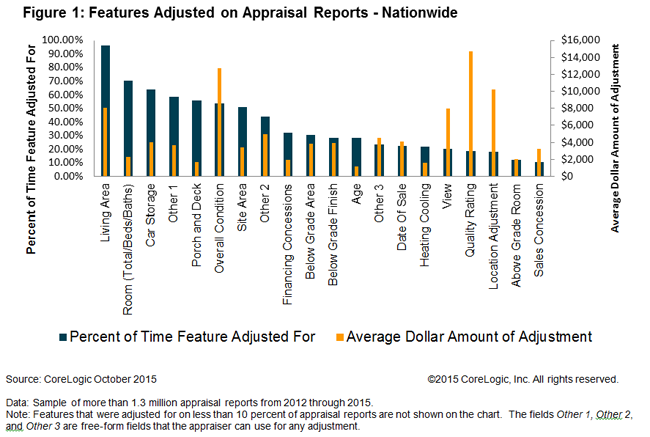
    Ranking Prevalence and Value Impact of Appraisal Adjustments

    It is the rare appraiser who comes up with a perfect comparable or “Comp” – i.e. a house of the same size and condition, close to the subject property, with similar amenities and that has recently sold.  Therefore adjustments must be made, and are actually made in 99.8% of appraisals.

    Adjustments credit or debit the subject property for the existence or absence of given features.  An example of a deck is one thing that distinguishes the subject from a close comp.  The comp has one, the subject property does not.  The appraiser would determine the value of the deck and subtract it from the comparison property’s sale value – arriving at an approximation of what that comp would have sold for without a deck.  Conversely if the subject had a deck and the comp did not, the value of the deck would be added to the sale price of the comp.

    Corelogic recently studied a sample of 1.3 million appraisal reports made between 2012 and 2015 to find the adjustments that are the most common and the adjustments that have the greatest impact on appraised value, and found 20 features which were common subjects for adjustment.  The frequency of an adjustment is indirectly correlated to the financial impact.  In fact, four of the top five most adjusted features resulted in relatively low average dollar adjustments

    Differences in living area was the most common adjustment, affecting 96.4% of appraisals and with an average impact of about $8,000.  Other features that were adjusted on 50% or more of appraisal reports were Room, Car Storage, Porch and Deck, Overall Condition and Site Area. For example, Room adjustments were very common at 70.4% but had minimal value influence, recording an appraisal adjustment of only $2,246 on average. Conversely, a Quality Rating adjustment had the highest value influence, with an average adjustment of $14,748, but accounted for only 18.7 percent of all adjustments.

    Prepare for the Visit of the Appraiser

    Remember, as appraisers have no relationship with any parties on the transaction anymore, unfortunately there will be appraisers who may not care what the final value is, as they get paid regardless of the quality of their work. Therefore, it is important to do what we can to improve the odds that the final appraised value is not left up to chance, so the value you need is met and your refinance will fund with no issues.

    If you have any questions about appraisals, or any concerns you would like to bring up before the appraiser comes out to appraise your home, please feel free to contact me directly via email or at 858-442-2686. So this way we can determine the best course of action to ensure you will get the value you need to meet your refinancing goals.

    9 Ways Buyers Can Accidentally Disqualify Their Loan Before Closing

    October 18th, 2012

    Underwriters have been warning us about buyers who have been accidentally disqualifying their loan before closing! Underwriters advise that buyers are going out and buying furniture on credit, or a new car before closing, or they change jobs, which unfortunately may now disqualify their loan before closing. These mistakes will happen and will continue to happen if buyers are not being coached properly before or during the loan process until they close escrow. Here are the 9 most common mistakes that buyers make which may accidentally disqualify their loan before closing.

    The 9 Most Common Mistakes Buyers Make

    1. Don’t buy a new car or trade-up to a bigger lease.
    2. Don’t quit your job to change industries or start a new company.
    3. Don’t switch from a salaried job to a heavily-commissioned job.
    4. Don’t transfer large sums of money between bank accounts.
    5. Don’t forget to pay your bills — even the ones in dispute
    6. Don’t open new credit cards — even if you’re getting 20% off
    7. Don’t accept a cash gift without filing the proper “gift” paperwork

    8. Don’t cosign on any debt with anyone(*You will be 100% responsible for it)
    9. Don’t make random, undocumented deposits into your bank account.


    WARNING: The Lender Will Pull Your Credit Again Before Closing

    It is also important that buyers are aware of a Rule that requires lenders to re-pull a buyers credit report just prior to closing and to look for any changes. If the “final” credit report doesn’t match the original credit report, the mortgage may be subject to a complete re-underwrite and, in a worst case scenario, a loan application denial.

    Lenders advise this ensures loans are priced properly and are funded on the borrower’s credit risk at closing as opposed to at application; because a lot can change with a buyers profile while a loan is in-process during a 30 or 60 day escrow.

    Some of the things underwriters are looking for include:

    * Did you apply for new credit cards while your loan was in-process?
    * Did you run up existing cards while your loan was in-process?
    * Did you finance an automobile while your loan was in-process?
    * Did you make some other major purchase while your loan was in-process?
    * Did you add non-disclosed debts while your loan was in-process?

    * Did you cosign on any debt with anyone?

    Each of the above is a red flag to underwriting, so it is important that buyers are aware of this rule and are being coached properly during escrow in regards to their credit. A golden rule for buyers to follow is, they should NOT purchase anything on credit until AFTER closing!


    A List of Buyer Do’s and Don’ts to Follow During Escrow!

    Here is a Do’s and Don’ts list below that I hand out to all my buyers when they start the initial loan application, I tell them to stick this on the fridge until they close escrow, as this list will serve as a reminder and ensure no mistakes will be made and everyone will have a smooth closing.

    It’s Important to Coach Buyers Right Through Until Closing

    I believe it is important that buyers are being coached properly until the close of escrow, and they have checklist of rules to follow between the date of application and date of closing, otherwise mistakes will happen.

    I continue to hear horror stories from my underwriters and friends in the industry, of buyers going out and buying furniture or something else on credit, or a new car before closing, and suddenly this new debt will cause their credit scores to drop, or their debt to income ratios are now too high, which means they do not qualify for the loan anymore. Therefore, a golden rule for buyers to follow is, they should NOT purchase anything on credit until AFTER closing!

    If you have any questions, or you would like a copy of this Do’s and Don’ts list above, please feel free to contact me directly at 858-200-9602 or by email at mdeery@citywidefinacialcorp.com and I would be happy to share it.
    .

    Conventional or FHA Financing: What’s Best for Buyers?

    October 4th, 2012

    Conventional or FHA, what’s best for buyers? Most buyers today assume that FHA financing, with it’s 3.5% down payment and expensive monthly mortgage insurance premiums “MIP”, is their only financing option if they only have a low down payment! Instead, show buyers how to purchase a home with a low down payment and NO mortgage insurance, using the Conventional 5% Down and NO mortgage insurance “MI” Program. Check out the huge savings when purchasing with this program versus FHA! In this $400k scenario below, the conventional buyer saves $375 a month over the FHA buyer and $35k over the next 10 years.

    Compare a $400k Purchase Using FHA vs Conventional

    Here is a scenario below that compares a buyer purchasing a $400k home with the “Conventional 5% Down NO MI Purchase Option”, versus a FHA buyer using FHA financing and 3.5% down.

    On the left column is the conventional option. The buyer has a loan of $380k (5% down), and gets a rate of 3.75% on a 30 year fixed. The buyers total PITI (principle and interest, taxes and insurance) payment is $2,176 a month.

    On the right hand side is the FHA option. The buyer has a loan of $386k (3.5% down) and gets a rate of 3.5% on a 30 year fixed. The buyers total PITI (principle and interest, taxes, homeowners including FHA insurance) payment is $2,552 a month. *This is an increase of $376 a month and $35k over the next 10 years!

    The conventional buyer saves $376 a month and $35k over the next 10 years. You can see below just how much more in interest and mortgage insurance the FHA buyer will pay in total over the next 10 years, compared to the conventional buyer.

    In Summary. Instead of buyers going with FHA and paying the expensive mortgage insurance each month, buyers should look into the conventional loan option too, because it will always have a lower overall monthly payment because there is NO monthly mortgage insurance.

    Also, monthly savings of $375 goes along way for many buyers these days! For example, it can mean a new car payment for some, or additional savings they can put into a college fund for kids or retirement. Or a buyer can also turn around and put the additional $375 monthly savings into purchasing a bigger home, in this scenario above, the conventional buyer can afford to buy $50k more in home, and still have the same overall monthly payment as the FHA buyer.

    FAQ’s About the Conventional 5% Down NO MI Program

    Here are a few of the most frequently asked questions that buyers and agents have in regards to the Conventional 5% down NO MI loan option.

    1. What is the maximum loan amount with 5% down?

    The maximum loan with 5% down is $417k which is the conventional loan limit. But this program is also available on Fannie Mae jumbo loans up to 90% loan to value, for example in San Diego a buyer can finance up to $546k (Fannie Mae jumbo loan limit) with NO monthly mortgage insurance.

    2. Can you get 5% down No MI on 2nd homes or Investment Properties?

    No, the 5% down option is for Primary Residences only. But you can still get 90% financing on 2nd homes with this loan program. This program is NOT available on investment properties as you have to put down a minimum of 20%, which eliminates mortgage insurance anyway.

    3. Why is there NO mortgage insurance?

    It is very simple. All a buyer has to do is take a slightly higher interest rate than normal, say from 3.5% to 3.75%. The additional yield (lender credit) available on the higher rate “buys out” the mortgage insurance. Essentially the mortgage insurance get paid off upfront using the lender credit.

    4. What credit score is required to qualify?

    There are a few lenders that only require a 620 credit score to qualify for this loan program. *But note the lower the credit scores, the higher the interest rate will be.

    5. Are there reserves required for this loan program?

    Yes, usually the program requires at least one month of reserves, which is equal to one monthly mortgage payment.

    6. Can the buyer receive the 5% down payment as a gift?

    Unfortunately NO, the 5% funds must come the buyer. The funds have to sourced and seasoned in their bank account for 30 days.

    7. Do condos qualify for the NO MI 5% down program?

    Yes, buyers can purchase condos with only 5% down and qualify for this loan option. *This is a great option in complexes that are NOT FHA approved.

    8. Isn’t FHA rates lower than conventional rates on this program?

    FHA rates are lower, but when you factor in the very expensive FHA monthly mortgage insurance, the overall monthly FHA mortgage payment will always be higher than the conventional payment. (*see scenario above for an example comparing both loan options).


    Tips for Buyers

    This is a great purchase option for buyers. This program helps buyers obtain home ownership with a minimal down payment, without having to pay expensive FHA monthly mortgage insurance every month, and gets them a much lower overall monthly payment. Now buyers can turn around and put the extra savings into a college fund or retirement, or back into the loan to pay it down, or even buy a new car with the monthly savings.

    But FHA is also a great program too, especially when buyers do not have the 5% down that is required for conventional, and are also getting a gift towards their down payment. Also if a buyers credit scores are below 700, FHA is sometimes a better option than conventional, as FHA is NOT credit score driven, whereas conventional financing is very strict on credit scores and interest rates are priced higher if credit scores are lower. The best thing to do is to compare both options, and see what is the best fit for your home loan needs.

    If you have any questions about this Conventional 5% down program with NO monthly mortgage insurance, or you would like to get per-approved for financing, please feel free to contact me directly at 858-200-9602 or by email at mdeery@citywidefinacialcorp.com

    Why 40% of Homeowners Are Doing “Cash in” Refinances

    June 27th, 2012

    “Cash-in” refinances have become very popular recently and actually accounted for over 40% of all refinancing activity in the first half of the year according to Fannie Mae, the highest amount on record. If someone wants to refinance at today’s low rates lenders require you to have some equity, if you don’t, you must add “cash in” to make up the difference. “Cash-in” refinances are now being used as a great investment tool by homeowners and can save lots of money, here is how.

    As there are very few investments out there these days that are paying a decent rate of return, “cash in” refinancing can represent a great opportunity to allow your money to work better for you and save additional money each month on interest and mortgage payments. Here are 4 examples when a “cash in” refinance pays off, these can also work the exact same way on a purchase loan too if buyers are looking to save extra money on their loan.

    When to put cash into your refinance?

    1.  You can lower your mortgage rate significantly: You know that you can qualify for the rock-bottom interest rates — as long as your loan balance is below a certain loan to value. Are you close to that cutoff and have plenty of cash to spare? Then bring enough funds to the table to push your mortgage balance below that threshold.

    2. Do you have a jumbo loan over $417k?  but are extremely close to the cutoff for a conforming loan (less than $417k)?.  Pay down the loan to under $417k  so you can get a much lower rate, as the average fixed rate on a 30-year jumbo is almost .5% higher than rates on a conforming loan.

    3. You can avoid mortgage insurance “PMI”. If your loan-to-value ratio is at a certain level that demands mortgage insurance. But you could avoid having to pay mortgage insurance by putting enough cash into the loan.

    4. You want to pay off your mortgage faster: Some homeowners are putting cash in so that they can afford the payments when they refinance a 30-year loan into a 20, 15, or even a 10-year mortgage, Even with the extra cash, your monthly payments will be higher on a shorter loan. But over the life of the mortgage, the total interest savings can be huge.

    How a “Cash in” refinance works

    Let’s take a look at an example in the chart below. These are the figures from a loan we funded for a family last week. They had a $300k loan and they qualified for a 3.75% on a 30 year fixed, or 3.49% on a 20 year fixed, but the payments on the 20 year loan were  too high as they did not want their monthly payment to be over $1,600.

    So they paid down their loan balance by $25k from $300k to $275k, so they could afford the payments on the 20 year loan, as the new payment was $1,593 a month. *Over the life of the loan the 20 year loan will save them $92,730 in interest over the 30 year loan, all for putting in an investment of $25k. Most people would agree that $92,730 is a great return on an initial investment of $25k.

    There are several different ways to determine if a “cash in” refinance makes sense. If you or anyone else you know needs help going over any of the examples above to determine if a “cash in” refinance would benefit your financial situation, please feel free to contact me directly at 858-442-2686 and I would be happy to help. I look forward to chatting soon.

    Appraisal Tips for Agents and Sellers to Protect the Contract Sales Price

    June 26th, 2012

    One of the main reasons that some buyers are not closing escrow these days is because of poor appraisals. We all hear about out-of-area appraisers who don’t know the local market, use of distressed-sale properties to appraise a property that is not being sold under distress, and lack of comparable sales. The key to a good appraisal is using accurate comparable sales and supporting data to arrive at an appropriate price for the property in question. Here are some appraisal tips for agents and sellers that will help protect the contract sales price!

    34% of Transactions are Affected by Bad Appraisals

    According to data from NAR in November and December, 34% of Realtors reported a problem with an appraisal in the past 3 months.  Approximately 10% of the respondents reported that appraisal problems led to contract cancellation; about 10% reported a delay as a result of an appraisal problem, and almost 15% reported that the appraisal problems led to lower prices.

    New HVCC Rules have Created Appraisal Problems

    We all know that Fannie Mae initiated changes in appraisal guidelines in 2009 with their new appraisal rules under HVCC (Home Valuation Code of Conduct) that prohibit mortgage brokers or real estate agents from selecting the appraiser to perform an appraisal on a purchase or refinance transaction.

    However, even though the loan officer can’t have direct contact with the appraiser, a real estate agent can. Here are some tips for real estate agents that will help move the appraisal process along smoothly, and ensure the appraiser has all the available information needed to complete an appraisal report that is NOT left up to chance.

    1. Meet the appraiser at the property.

    Don’t ever let an appraiser just do the appraisal without taking the opportunity to meet with them and explain any specifics about the property, otherwise the odds of a poor appraisal report are higher! The buyers or sellers real estate agent should always plan to meet the appraiser at the property to offer relevant comparable sales information. Make sure you are the contact to schedule the appraisal and then go meet the appraiser at the property and find out if he knows the area, what data is he using etc, many times appraisers are from out of town too, so it is important you explain any specifics about the surrounding area that may impact the final value.

    2. Improvement list provided to appraiser

    If improvements have been made to the property, or there are features that don’t meet the eye, a list should be provided to the appraiser so they can include this in their final report. If possible, include before and after pictures, and copies of paid receipts for the work completed. If major updates were done, provide a detailed copy of the contractor’s bid.

    3. Public records are often wrong

    The public record is often wrong, particularly regarding square footage. Any documentation to justify a different number should be made available. According to current appraisal guidelines, square footage added without a building permit usually won’t get credit as usable square feet. This can lower the appraised value.

    4. When there aren’t enough comps for past 3 months

    When there aren’t comps for the past three months, it’s critical the appraiser is provided with the data upon which to make an accurate evaluation, particularly if the appraiser is unfamiliar with the local market.

    Preparing Sellers for the Appraisal

    We all know that appraisals are one of the major hurdles for sellers, buyers and lenders these days on a transaction. So here are some tips for sellers to follow, that will help move the appraisal process along smoothly, and will ensure the appraiser has all the available info needed to complete an appraisal report that is NOT left up to chance.

    1. Compile a list of recent improvements. If possible, include before and after pictures, and copies of paid receipts for the work completed. If major updates were done, provide a detailed copy of the contractor’s bid.

    2. Make sure all areas are accessible, including the attic, basement and crawl spaces. This includes the garage.

    3. Provide HOA information. If the home is part of a homeowner’s association, include a copy of the fees paid and name and phone number of the association president or association administrator.

    4. If the appraisal is for an FHA loan, then the area leading to the attic will have to be cleared and made accessible-the appraiser is required to make at least a head and shoulders inspection of the attic area.

    5. Install carbon monoxide detectors. This is now CA law (see below) that carbon monoxide detectors are installed on each level on a home. If these are not installed when an appraiser shows up to do the appraisal, the lender will ask that these are installed in the home and will ask the appraiser to go back out to the home again to take a picture to verify they were installed. This can cost up to $175 for a re-inspection, so installing these before the appraiser shows up will save you money.


    6. Straighten up each room. Appraisers are required to photograph each room, and while it may not make a difference to them if the room is messy, there is an underwriter who may be less objective.

    7. Finish up any projects. If there are any unfinished projects, make sure the seller completes them before the appraiser’s inspection.

    8. If there are any easements, encroachments or any unusual covenants associated with the title, provide a copy to the appraiser.

    9. Provide For Sale By Owner information. If the seller knows of any recent “For Sale By Owner” sales in the surrounding neighborhood that will help support the value, ask them if they are able to get additional information from the home buyers living there now.

    Doing the necessary homework upfront on transactions is key

    It is key these days that the necessary home work is done upfront on transactions before the appraiser comes to the home. As appraisers have no relationship with any parties on the transaction anymore, unfortunately there will be some appraisers who do not care what the final value comes in, as they get paid regardless of the quality of their work! Therefore it is important to do what we can to improve the odds that the final appraised value is not left up to chance.

    If you have any questions about appraisals, please feel free to contact me directly at 858-200-9602.